

Through my work with academics from around the world, I have come to realize that, as Chileans, we have all the necessary skills to contribute to the development of solutions and the advancement of knowledge.
In a world where knowledge and innovation are key to a country’s global standing, María Thomsen’s career highlights the contribution Chile can make in these areas. With experience in applied research and collaboration with institutions such as NASA, her work bridges science, talent development, and global networks. In this interview, she discusses Chile’s role in international knowledge ecosystems and the challenge of bringing more Chilean talent to the world stage.
Based on your international experience, what makes Chile a reliable and attractive country for science and innovation today?
Chile is a country that offers many opportunities for researchers and academics working in STEM-related fields. The fact that we are a developing country that consistently invests in research and innovation through public funding programs allows many of us to develop our research proposals in a way that is competitive on an international level, while also enabling us to share our work with the broader community.
Similarly, I believe that Chile is home to a great deal of talent working on various societal challenges, which are also relevant on a global scale. As a result, I believe we have gradually built up that image of trust and relevance on the international stage.
The program developed in partnership with NASA gave Chilean students a unique opportunity to gain international experience. What impact do you think initiatives like this have on showcasing Chilean talent to the world?
These types of activities are extremely important for the development and education of people in Chile. Participating in activities like those offered through the NASA program allows our students and future engineers to grow and envision their futures in a different way—with a broader, more global perspective on potential future options—and to understand that there are various paths of specialization they can explore for themselves. Furthermore, I believe that interacting with students from other universities in a setting different from the usual one—experiencing technological advancements, laboratories, and more firsthand—motivates them and brings classroom content to life in a much more impactful and engaging way.
You are part of a generation of women who are leading the way in high-level scientific fields. What message would you like to convey to girls and young women in Chile who today see science and engineering as a viable career path?
The message I’d like to convey to girls and young women who are interested in pursuing a career in science or engineering—and even to those who may not be so sure—is that they shouldn’t be afraid to try out and experiment with what they enjoy, that they should approach the teacher they trust the most and talk about the things they’d like to do, the concerns they may have that make them question whether to pursue that path, and about possible opportunities that might exist to delve deeper into the subject that interests them. In short, “believe in themselves,” trust their own abilities, and take advantage of the fact that they are young and at a stage where they can explore different areas and try different things without major consequences; they shouldn’t stop pursuing what they love out of embarrassment or fear of what others might say.
The talent Chile showcases to the world
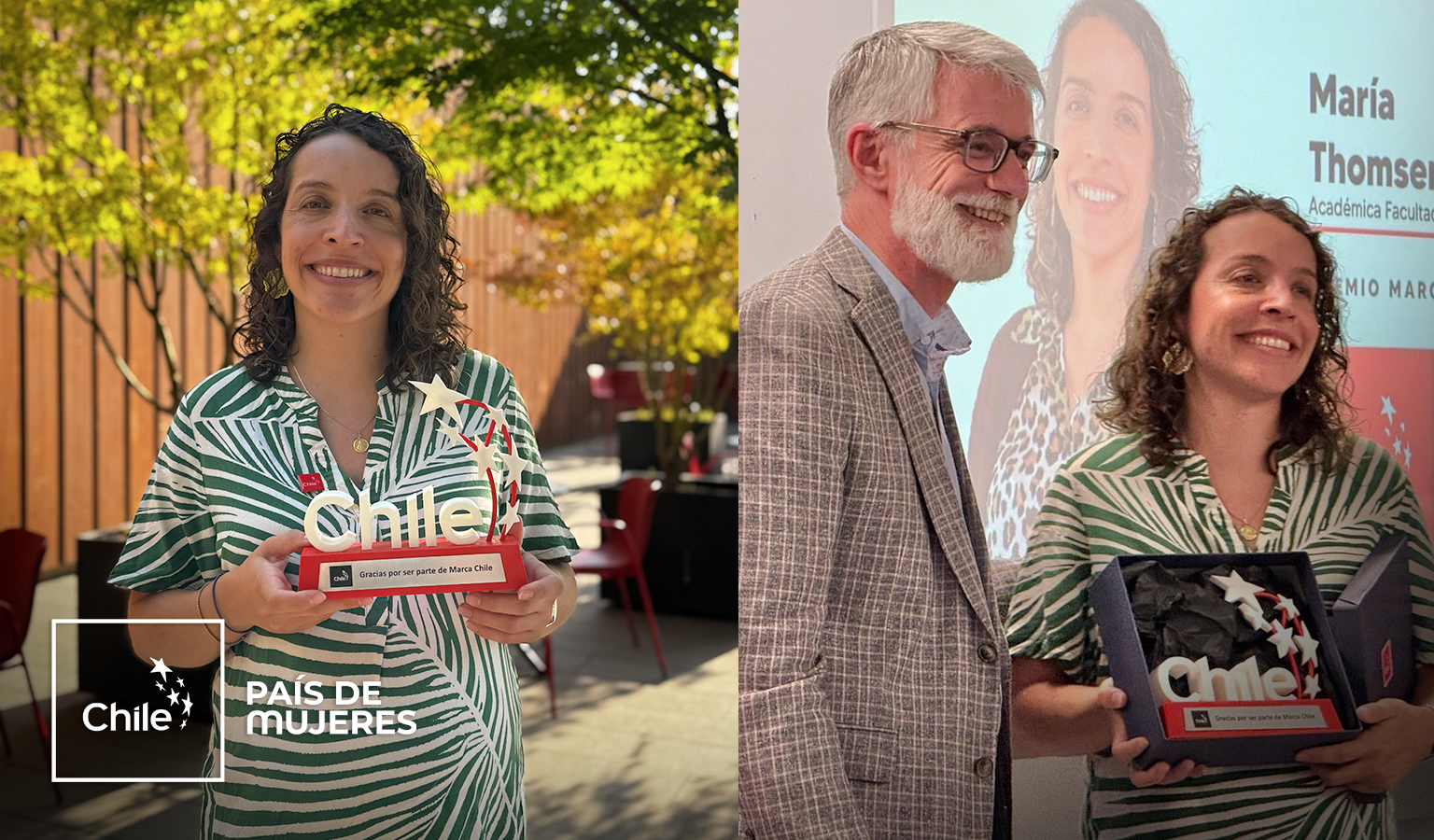
As part of the Adolfo Ibáñez University (UAI) International Distinction Ceremony, which honors academics with international impact, the Marca Chile Award was included for the first time this year. The award aims to highlight those who, through science, innovation, and talent development, actively contribute to positioning the country on the international stage. In this inaugural edition, María Thomsen was recognized for her contribution to raising Chile’s profile in global knowledge ecosystems.
Now that you have received this award, what does it mean to you to represent Chile in global scientific and academic circles?
Receiving the Marca Chile Award fills me with pride and makes me very happy because, in a way, it recognizes the work I’ve done throughout my academic career and validates the decision I made a few years ago to give back to my country after completing my doctoral studies. I believe that when you conduct research—regardless of the field—it is not something that can, or should, be done in isolation.
Working with academics from around the world, I have come to realize that, as Chileans, we have all the capabilities needed to contribute to the development of solutions and the advancement of knowledge. Chile has a wealth of talent and opportunities for growth for those who want to make a difference and contribute. Moreover, I believe that the realities we face as a society also compel us to look outward and contribute, from our perspective, to solving global problems—such as, for example, developing solutions and measures that allow us to better address the devastating wildfires we face year after year.
Your work operates at the intersection of knowledge and international collaboration. What role do you think Chilean universities should play in shaping Chile’s international image?
I believe that Chilean universities play a key role in fostering the talent they attract. In Chile, much of the research work takes place within universities, and therefore this is something that should be leveraged and maximized. It is essential to have ecosystems that enable the development and recognition of academic work and international collaborations in this field.