Night falls in Greenwich Village, New York’s traditional bohemian neighborhood. Locals and tourists alike crowd into minimalist-style bars, while lines form outside the Comedy Cellar, the mecca of American stand-up comedy. A couple of blocks away, tucked away among the neighborhood’s classic architecture, is a small restaurant: Tokyo Record Bar, a “vinyl bar” that combines a curated musical selection with a seven-course tasting menu by Ignacia Valdés, a Chilean chef considered one of the most promising stars of the country’s culinary scene.
Despite its intimate and unpretentious atmosphere, the restaurant has gained recognition in one of the most competitive neighborhoods on the planet. Celebrities such as Olivia Wilde and Pedro Pascal have dined there. Part of the reason behind this success is Ignacia, who, at thirty years old, is already a veteran in the kitchen and has imbued Tokyo Record Bar’s menu with a unique identity, blending flavors from Japan, Chile, France, and around the world.
You’ve worked in Paris and now in New York at top-tier restaurants, some of which have even earned Michelin stars. How do the lessons you’ve learned from that experience connect with your Chilean identity?
I think Chileans are stubborn and have strong personalities. In the kitchen, you have to have grit to handle long hours, high-stress environments, and a lot of physical labor. We live in a country where things haven’t always been easy, and that forces you to develop a personality that can hold its own.
Your cuisine has been described as a blend of Chilean roots and Japanese techniques—two traditions in which the sea plays an important role. What role do ingredients from the Chilean sea play in your cuisine?
I feel that growing up in Chile, going to the coast with my family, and eating sea urchins, abalones, oysters, and fresh fish from a young age instilled in me a deep love for the sea that has always been present in my cooking. From Japanese cuisine, I’ve incorporated simplicity and respect for fresh ingredients, minimizing intervention; and, on the other hand, French cuisine gave me a love for sauces. I like to play with all those elements.
But the flavors of the Chilean sea are unlike any others in the world. I've never tasted sea urchins as delicious as the Chilean ones, nor oysters with such an intense flavor.
New York is probably one of the most competitive culinary scenes in the world. What has it been like to find your own voice there?
This is my first position as an executive chef, and it’s been a great learning experience. I’ve been working in the kitchen for almost ten years, and you pick up things from different places until you reach a point where you have to ask yourself what you really want to express through your cooking.
I don’t feel that any specific traditional cuisine represents me. I’m more interested in creativity, surprising people, and creating experiences—while always ensuring that the food is delicious and leaves you wanting more. I love fine dining, but I don’t like the formality that sometimes exists in that world. I want to create something sophisticated, using technique and high-quality ingredients, but without it becoming stressful or overly serious.
You were a finalist in the S.Pellegrino Young Chef competition, a major international event. In your dish, you incorporated ingredients such as cochayuyo, merkén, and luche. What were you trying to convey with that dish?
I’m 100% Chilean, so I wanted to use Chilean ingredients and showcase them to the world. The dish was based on a Japanese fish that I love, and I wanted to prepare it using every part of the fish, inspired by a more sustainable approach to seafood cuisine.
I created various dishes using the whole fish: a sauce made from the heads, chips made from the eyes and tapioca, and a glaze made with cochayuyo and merkén. I wanted to combine Japanese techniques with Chilean flavors and also address the issue of sustainability.
I was exhausted by the time the final rolled around: I’d burned my hand, I had a stye, and I was a wreck. But I met some incredible chefs and tried to treat it more as an experience than as a competition.
Tokyo Record Bar offers an experience deeply rooted in music, memory, and the senses. What stories do you hope to tell through your cuisine?
For me, eating is all about pleasure and the senses. This restaurant has something very special about it because it doesn't take itself too seriously. There's music, there's humor, and there's a slightly silly, fun vibe that makes the experience more relaxed.
I'm really interested in the element of surprise. I like to combine unexpected ingredients, put a twist on traditional dishes, or experiment with flavors that people might think they don't like.
That’s the fun part about tasting menus: people don’t get to choose, so they’re open to trying new things. Often, someone will say they don’t like octopus or sea urchin, but they end up loving it. It all depends on how the flavors are prepared and how the ingredients are balanced.
Do you feel like an ambassador for Chile through your work?
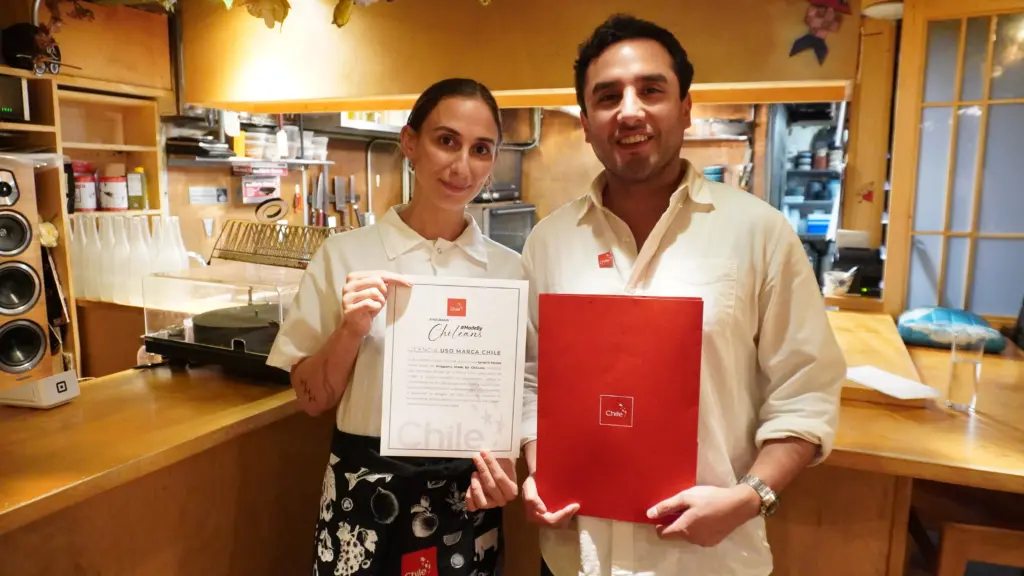
I feel that we Chileans are very proud to be from our country. When a Chilean hears another Chilean speaking on the street, they automatically want to go over and say hello. So yes, in a way, all of us who are abroad represent Chile to some extent. I, for one, feel very proud of where I come from.