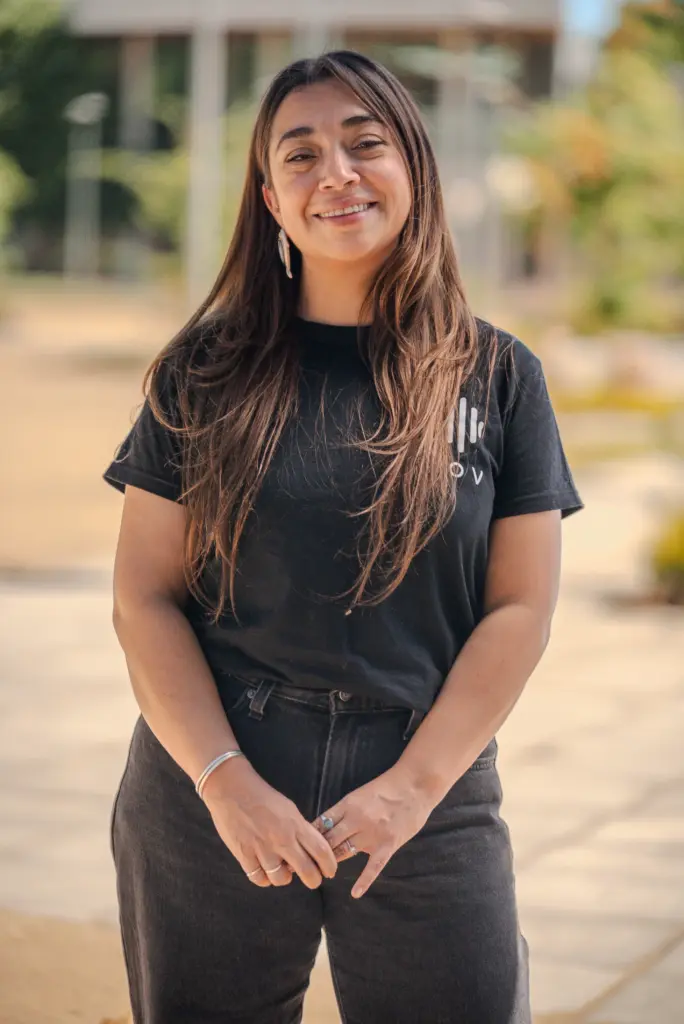
What began as a thesis project at the University of Talca ended up becoming an internationally recognized innovation. Based in the Maule Region, Chilean designer Silvana Herrera Leiva led the development of MOV, a sensory band that uses technology inspired by echolocation to detect obstacles and assist people with visual impairments in getting around.
The initiative combines inclusive design, technology, and empathy to address a specific need of thousands of people. Thanks to its social impact and innovative potential, the project was honored in 2025 with the Ingenias LATAM Award, presented by the European Union Intellectual Property Office (EUIPO)—a recognition that highlights innovative women in Latin America who are driving change from their regions out into the world.
“We are tremendously proud to have earned recognition from the European Union, because it highlights the work we are doing in Chile—and especially in the regions,” Silvana says in this interview.
Where did the idea to create this sensory band come from?
The idea originated from my undergraduate thesis project at the University of Talca’s School of Design, where I began working with people with visual impairments. We conducted field research, observing how they got around, and realized the problem they had with the white cane, as it led to long-term physical issues. And we asked ourselves: if they lose their white cane in an enclosed space, how can they find it? The answer lies in sound. This is called echolocation. We conducted research using biomimicry, looking at which animals use echolocation, such as bats and dolphins. And we realized that while dolphins aren’t visually impaired, they do catch their prey using echolocation. After all this research, MOV was born—a sensory band designed to aid spatial mobility for people with visual impairments. It uses laser sensors to map the space and alert the user to the location of objects.
Was there any experience that paved the way for this invention?
Yes, in fact, I spoke with several people with visual impairments. I remember I was walking down the street and ran into Michael, who is completely blind, and together we began conducting field observations, and I started to realize several more personal things I had regarding the issue of free mobility. I also realized that in the field of design—at least here at the regional level—inclusive design wasn’t very advanced, so that’s what motivated me to keep working on this project.
Thanks to your technological advancements, people with visual impairments are now better able to perceive their surroundings. How do you see this impacting their quality of life?
We’ve seen this in the usability tests we’ve conducted. Rather than focusing on the long-term benefits, we aim to make them feel included in the evolution of design and technology. We want to create a device that doesn’t look like a medical aid, but rather something contemporary that helps them feel much more included in society. We also realized that it helps them prevent accidents in the long run with something as simple as walking. We want this to be a technical aid—a tool that enhances their quality of life, allowing them to move about freely and feel that they don’t necessarily need to have both hands occupied holding a cane, for example, or worry about potential accidents. Instead, they can do very simple things, such as walking hand in hand.
Your innovation crossed borders and was recognized with an award from the European Union. What did that recognition mean to you?
It validated what we’ve been doing so far with MOV. I couldn’t believe it—I still can’t believe that our work with MOV and the sensory band, as well as our research in the area of inclusive design, has been recognized. At first I felt proud, then I experienced imposter syndrome—which I think all of us women here struggle with a lot. But I also felt a sense of satisfaction that what we were doing was being showcased. For us, it’s been a tremendous source of pride to have earned recognition from the European Union, because it brings visibility to the work we’re doing from Chile—and especially from the regions.
Do you see any differences between the innovation and technology being developed in Chile and that being developed in more advanced markets?
I think the field of innovation and technology outside of Chile is a bit more advanced. For us, it’s been quite a challenging journey because, even with the limited resources we’ve had, we’ve kept moving forward and working, and we’ve managed to develop this technology—which isn’t as advanced, is a bit more analog, but does work. There are other technologies related to visual impairment, but they’re very advanced and, as a result, too expensive for users to purchase directly. So yes, these technologies exist, but they aren’t very accessible to users. MOV has the advantage of being a device that’s directly accessible; it isn’t an expensive system, and it’s easy to use.
Is there any aspect of Chilean society that you identify with and that has shaped the development of MOV?
There are certain traits of Chilean women that I completely identify with, and they have to do with being stubborn. Yes, I’m very stubborn when it comes to believing that something will work, and I just keep at it. I’ve been working on this project for six years now, and I still believe in it. Also, not giving up on things—I almost always talk about failure. We’ve failed a thousand times with this, and we keep at it because failure gives us insights into what’s wrong so we can fix it.
What would you say to Silvana when she was 16 or 17?
I’d tell her to turn into Bulma from *Dragon Ball Z*. I love *Dragon Ball Z* and used to watch Bulma, so now I think, yes, I’m turning into Bulma. But when I think about Silvana at 60, I think I’d like her to still be working. I really love my job. I’d like her not to be retired—I’d like her to be able to keep contributing her knowledge at age 60 and sharing stories about what we’ve accomplished and what we’ve done with MOV.