From the very beginning of the world, a global solution was born. IMEKO developed pioneering technology to recover the cellulose acetate contained in cigarette filters and transform it into a new raw material for manufacturing sustainable products. Its chemical process, unique worldwide, has made it possible to turn one of the most polluting types of waste into an alternative for the circular economy.
This innovation has helped the company expand its reach internationally. In 2024, together with the Chilean firm Karün, it unveiled at the MIDO trade show in Milan—the world’s leading event for the optical industry—the first eyeglasses made from a material derived from recycled cigarette butts. In addition, the technology received funding from IDB Lab to support its international expansion and is certified as a B Corporation.
Behind this innovation is chemist Valery Rodríguez, who, in this interview with Marca Chile, shares her perspective on the role of applied science, technological entrepreneurship, and Chile’s potential—in her view—to develop sustainable solutions with a global impact.
Now that your work and that of IMEKO have received international recognition, how does it feel to show the world that your capacity for innovation knows no bounds?
It makes us proud. It’s very rewarding to know that what we’re developing is having an impact, that it’s being well received around the world, and that the community understands what we’ve been trying to convey—because the work we’re doing to eliminate such a polluting form of waste from the environment goes hand in hand with environmental education, so that people understand the purpose behind it: why we’re developing this technology and why we want to solve this problem. I think the response we’ve received from those around us—both in Chile and worldwide—has been very positive, because we’ve started a movement to eliminate cigarette butts from the environment that didn’t exist before.
Today, Chile is a pioneer in this field; it is the country where the topic of cigarette butt recycling is discussed the most in the world, and this is thanks to what we have developed at IMEKO.
In that context, what does it mean to represent Chile and Chilean women?
I think there’s a sense of responsibility—which is certainly positive—but it also presents the challenge of ensuring that what we’re doing doesn’t remain just an idea, but that we continue to develop it. That we make it of exceptional quality, that we bring more people on board to solve this problem—we’ve undoubtedly been pioneers in providing a solution, but we’re not the only ones who need to be involved in solving this problem. But without a doubt, it feels great to know that we’re making waves worldwide with this solution.
Do you think IMEKO represents a way to take science from the lab and apply it to solutions for everyday life?
I don’t know if it’s a revolution, because I’m also aware that there are many scientists around the world—not just here in Chile—who have developed great solutions, but I am convinced that this is the path we need to pursue, and it’s something we at IMEKO have wanted to promote: that science has all the tools—and that there is great capacity and potential—so that, through science, we can develop solutions that have a global impact and an impact on people’s daily lives for problems that often seem overlooked, but for which we can create solutions through science.
Looking back, how would you describe the journey IMEKO has taken, from when it was just an idea to the recognition it enjoys today?
It’s been a difficult journey. For any entrepreneur, the path of entrepreneurship isn’t easy, but for me—and I think for what IMEKO has become—it’s been a very rewarding journey, one marked by strong conviction, by believing more and more in our purpose, and by reaffirming our commitment.
I think this journey has shown us that we’ve been doing things right. There are always things that could be improved, or things we’d like to see work better, but without a doubt, the journey has yielded great results. Today we have a very valuable team and a meaningful project, and I believe that the IMEKO that started out is very different from what it is now, but it has never strayed from its purpose—the clear vision of where we’re headed and what we want to develop and solve.
Is there room for innovation in the development of sustainable solutions?
Yes, I believe there is room for innovation, I believe there is room to develop public policies, and I believe there is room for entrepreneurship—but we must have a clear vision. Sustainability is a path where it’s often hard to see the way forward; it’s not easy to tackle. But I’m also convinced that in Chile we have a great deal of talent and capacity to develop solutions that are truly sustainable. Especially because I believe we have an environment—we have a very rich country—that we must care for in terms of its nature and biodiversity, and I believe we should always keep in mind the goal of developing a sustainable path to care for those environments, to protect and preserve those spaces and that biodiversity. I believe this must be done through various disciplines, with a set of solutions that never lose sight of the fact that we are developing talent and solutions, but doing so in a sustainable way.
A “Genie” in Action
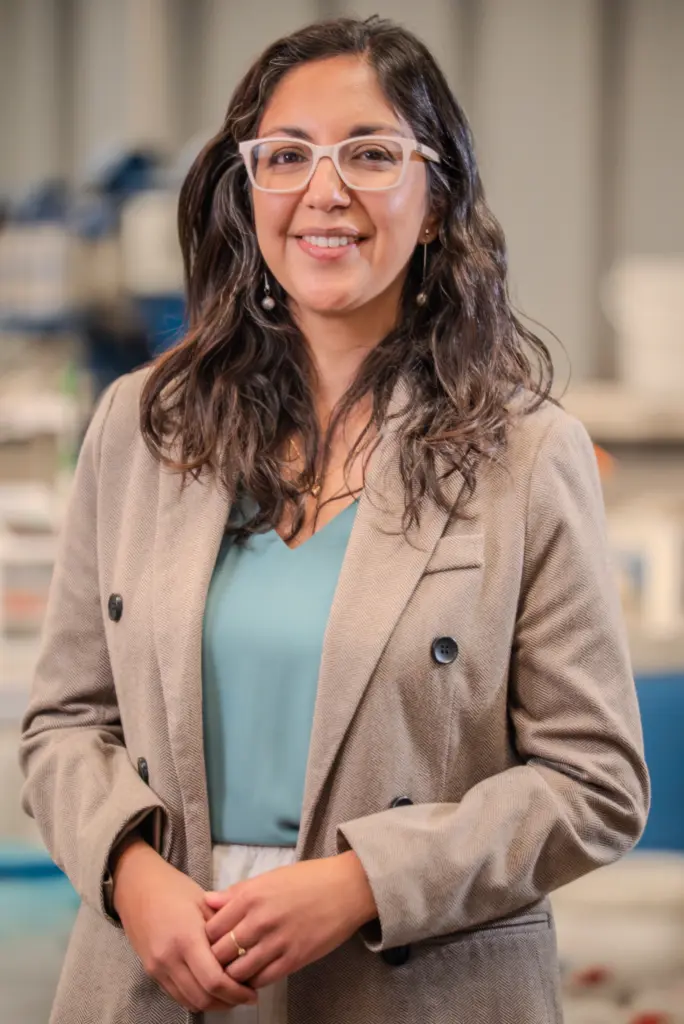
Valery Rodríguez’s work was also recognized at the 2025 Genias Awards, where she received the special “Genias Marca Chile” distinction, a category that highlights women whose initiatives have the potential for international impact and help position Chilean talent, science, and innovation on the world stage. For the scientist, this recognition also represents an opportunity to inspire new generations of women to develop their own ideas and take them beyond the country’s borders.
What does it mean to you to be a Chilean woman?
For me, being a woman and a Chilean means being brave; it means having the ability to do a little bit of everything—which is what we do as entrepreneurs. I believe that women are always willing to get things done and are constantly juggling many things at once—family, home, work, and studies—and I think these are qualities I’ve had to bring to my business. That ability to do a little bit of everything, I believe, is tied to our identity as women—the fact that we can thrive and grow in multiple areas at the same time.
Finally, what would you say to the girls and young women who are thinking about studying science today?
To all those girls who want to study science, to those who are still undecided, or even to those who are already studying but still lack confidence—believe in yourselves. Science offers many paths to explore, with opportunities for growth in many areas and fields, and all of them, without a doubt, make an impact. I’d also tell them not to set mental limits for themselves—that’s something I’ve always wanted to convey—and not to let anyone tell them where they can or cannot be, or where they can or cannot thrive. Believe in your abilities and work hard, because opportunities don’t just come to you; you have to seek them out and work for them. Dreams can come true.