At an age when many are just beginning to chart their course, Matilde Gaete is already moving with determination toward a goal that is rare in Chile: becoming an astronaut. As a physics engineering student, her journey combines academic training with early experiences in the aerospace field, which have given her firsthand insight into the challenges and opportunities of this expanding industry.
Her participation in specialized programs in the United States—including the Advanced Space Academy, where she was part of the first all-female Chilean team to complete this training—marked a turning point. Added to this is a first-of-its-kind achievement in the country: she became the first civilian to train in a Chilean Air Force aerospace program, opening up new possibilities for talent development in this field.
“For as long as I can remember, I’ve loved everything to do with science and the universe. That’s how I came to discover that people were talking about a new era of space exploration in the coming years—that deep-space missions would resume, going beyond Earth’s orbit—and I want to be part of this new era. I can be part of it either by developing technology here on Earth or by going out to explore space,” says Matilde, who is one of the eight Women Leaders in Development highlighted by Marca Chile.
You were the first young Chilean woman to attend a training session at NASA. What was that experience like, and what did it mean to you?
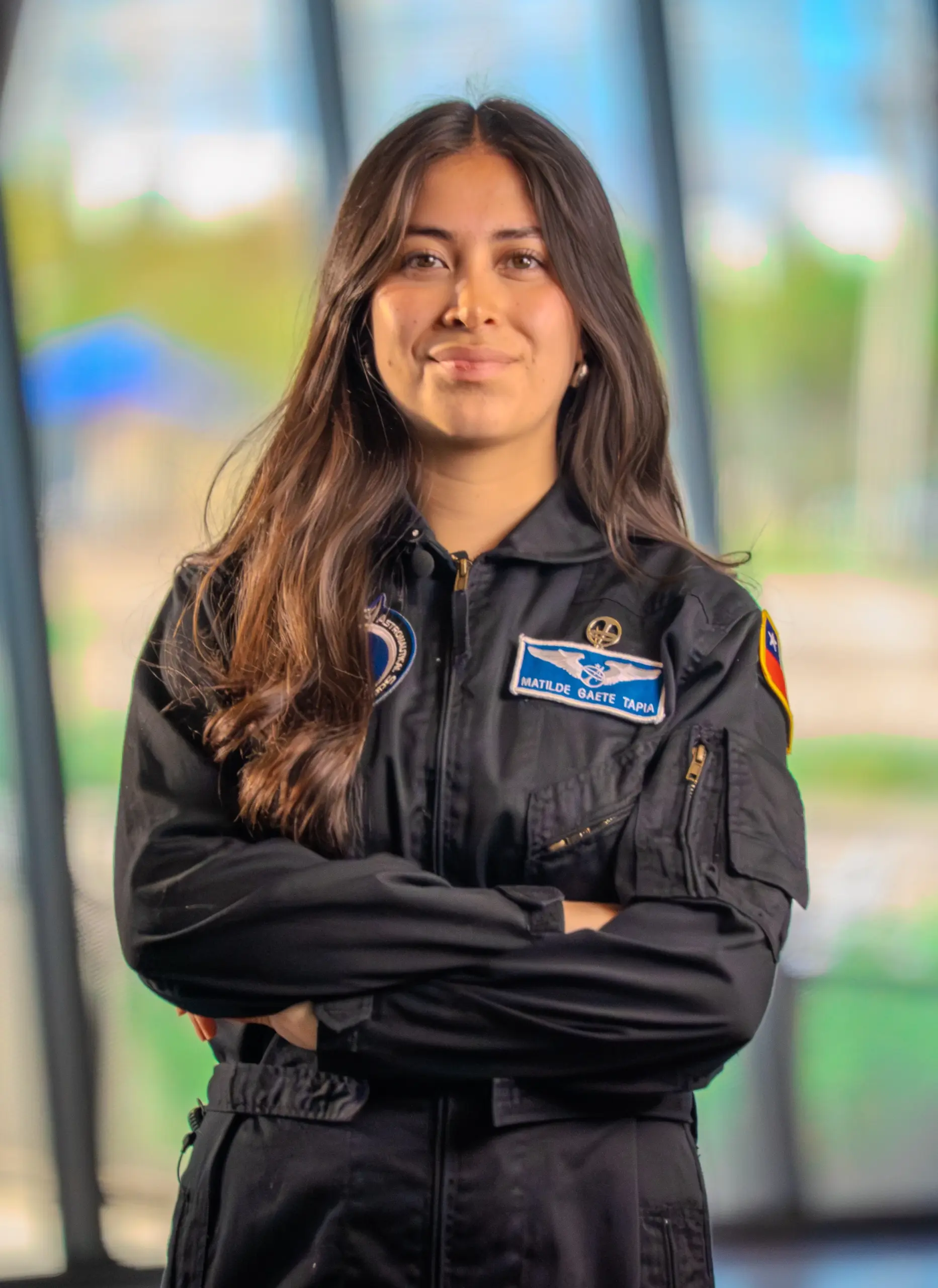
We were the first generation of Chilean students to attend this nine-day NASA space training program. It was my first real introduction to the world of space. Although Chile is just beginning to make inroads in this field, there I was able to take classes with active NASA astronauts, retired astronauts, rocket developers, aerospace systems engineers, and others.
That really helped me understand what’s going on in the aerospace industry, what the challenges are, and so on. It was a huge help in guiding me, because I was in my senior year of high school and had to decide what to major in.
Later, I participated in a training program with the Chilean Air Force, which made me the first civilian to take part in this aerospace training. These experiences fill me with pride because I believe we’ve shown that it is possible in Chile—that we have the talent, the motivation, and the opportunity.
What have been the main challenges you've faced on your journey to becoming an astronaut and continuing to grow in the space industry?
My first international program opened up various paths for me to continue my training in line with the mission profile I aspire to, because in a space mission there are different roles within the crew. I need to keep traveling mainly to the United States, where the space agencies are located, to train in capsule egress, systems engineering, and to familiarize myself with the spacecraft’s systems. But when it comes to challenges, I believe there is definitely a geographical and language barrier, because space development is concentrated mainly in the northern hemisphere. And I think the other challenge is more of a communication one—explaining why space is important, why we need to invest in putting satellites into orbit, in sending experiments to orbit the Earth, and in taking humans beyond Earth. I think there’s a significant communication challenge there.
What role or area of a space mission interests you the most?
To reach the International Space Station, which has been in operation for several years now, you travel in a capsule that can hold only four astronauts: the commander, the pilot, and two mission specialists. Why? Because the idea is that when you go to space, you’re not just going to look at Earth from space—you’re going to do science, you’re going to conduct research, and that’s the role of the mission specialists. I’m very interested in that role, and I’d also like to be a pilot. I’ve always been told that I’m very STEM (an acronym for Science, Technology, Engineering, and Mathematics), so in general, many areas catch my attention, from pharmaceuticals to space medicine—because today we talk about space medicine, understanding how space conditions affect the human body—that’s also an area I’m really interested in.
Why is it vital for Chile to continue making progress in the space sector?
These days, people are talking about the space economy. It’s a real thing—I’m not making it up. It’s a term used by the OECD, and it’s a market that’s growing rapidly. We can’t afford to fall behind. Now is the perfect time to join this new era of space exploration. Plus, Chile has a lot to offer: we have talent, brilliant minds, and now we have the infrastructure; we have the clearest skies, and we also have a geographical diversity that’s incredibly useful for research. In northern Chile, the world’s driest desert, the environment is the most hostile and similar to the conditions we’ll encounter on Mars. So we could also set up a simulated training center, for example. Chile has a lot to offer.
What would you say to other girls who see space as a place they want to go?
I really love thinking back to the moment when I said, “I want to be an astronaut.” I was just a little girl, but what I did was Google “Chilean astronauts,” “Chilean space agency,” and “Chilean NASA.” We didn’t have one, but that didn’t discourage me—quite the opposite. It motivated me even more to take on that pioneering role so I could open up these opportunities for other girls and young women who want to be part of this world. My advice is that if you find a field you truly love and are passionate about, and you realize you’re the first one there, don’t let that discourage you. Embrace that role and that responsibility with pride, with a desire to open up those opportunities for future generations.
Do you think Chile is a country that can export innovation and talent?
Absolutely. And I see this in the programs I work on abroad. I interact with young professionals from all over the world, and I always tell them that the education I received here in Chile has been fantastic. I feel very confident in STEM fields. So Chile definitely has a lot of talent—many brilliant minds who can help solve global problems and challenges. We have a very good education system, and perhaps those talented individuals hold the solutions the world needs. We have a lot to contribute from Chile.