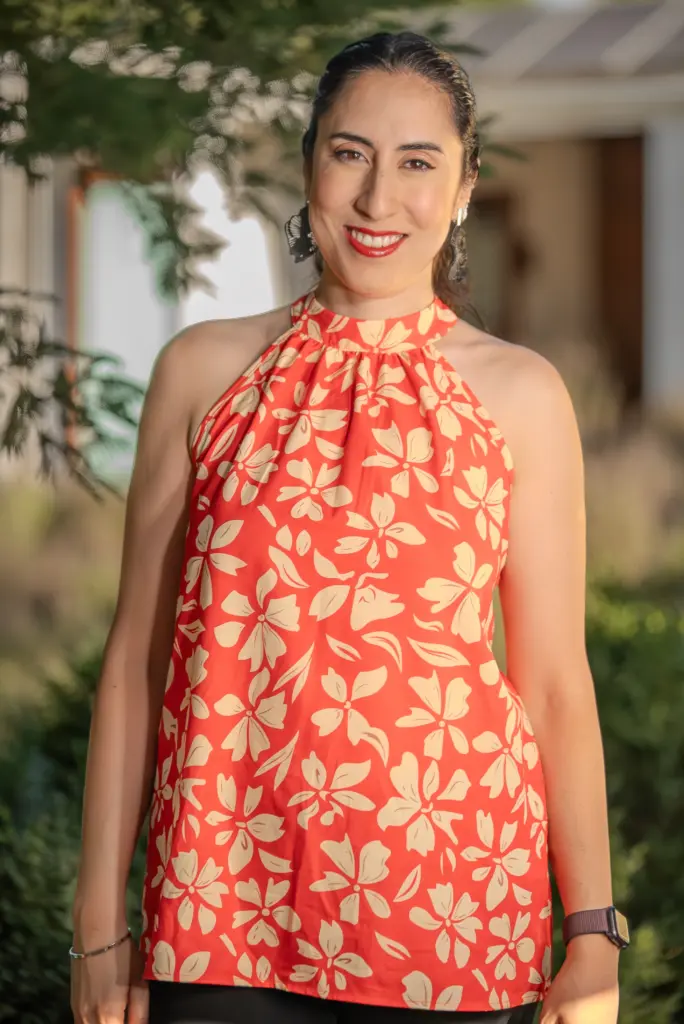
What began in 2002 as a project to raise awareness about animal testing in the cosmetics industry has now evolved into Te Protejo, an organization that promotes certifications, research, and advocacy initiatives to foster a cruelty-free beauty industry in various Latin American countries. Through this work, its founder, Camila Cortínez, has forged connections with various markets. However, she insists that this expansion has never altered what she considers essential: the project’s Chilean origins and the way in which they continue to shape her approach to her work.
It all began with a volunteer position at the CODEFF Wildlife Rehabilitation Center. That experience raised Cortínez’s awareness of the impact of consumer choices on the environment and animals—a concern that led her to found Te Protejo in 2002 and transform a personal concern into an initiative with international reach.
In this conversation, he looks back on that journey, reflects on the challenges of promoting an initiative that originated in Chile beyond its borders, and explains why he believes that professionalism, resilience, and the ability to build trust are qualities that today set him apart in the way he represents the country abroad.
“Coming from Chile has left its mark on us. We know what it’s like to face challenges, but we also know how to be professional, how to work, and how to build trust. That gives us a lot of strength and confidence when dealing with people from other countries,” Cortínez says in this interview.
What was the journey that led you from volunteering with the Committee for the Defense of Fauna and Flora to later founding Te Protejo in 2002?
I volunteered at the CODEFF Wildlife Rehabilitation Center because I became more aware of how my actions were impacting the environment. I started doing a little more research and learned about animal exploitation and how our country’s wildlife was being affected. I wanted to do my part to help those animals that were brought to the center as a result of human activity.
How did you come to this change in perspective, and how did that lead you to found Te Protejo?
I began to realize how my actions affect others—whether people, the environment, or animals. I started making more conscious choices about my consumption. And along with that—given my love for makeup and hair products—I began to investigate the environmental impacts of the cosmetics industry. I became interested in the issue of animal testing. At that time, in Chile, there was very little content and very little information available about what was happening with animal testing for cosmetics. Te Protejo filled an information gap that existed regarding the reality of animal testing for cosmetics. And in a way, it served as a springboard for me to inform many people about this issue and about the impact of their day-to-day consumption choices.
How did your years of experience protecting wildlife, particularly in Chile, inspire you to seek change on a global scale?
Ever since we started making changes at Te Protejo, we’ve seen brands and startups getting certified. I think that as a woman, my defining trait is that I always want more—not from an ambitious standpoint, but from the perspective of impact. So, with that vision in mind, we began to grow and trust that if we set out to ban animal testing in Chile, it would happen—and now we’re thinking, well, maybe in Argentina, Mexico, Brazil, and Peru, too. We want the message to reach more people and for more legislation and more brands to truly stand with us. That journey gives us the confidence to approach larger companies, conglomerates, and other countries—and to work on behalf of animals there as well.
What would you say is the Chilean touch you bring to your work to set yourself apart and break down barriers?
I believe that what defines being Chilean is being very professional in a challenging context. I think the professionalism found in other countries—in Europe, perhaps even in the United States—stems from a context of privilege, from being a major power, whereas in Latin America we’ve always faced a bit more difficulty in growing and developing. I believe that coming from Chile leaves its mark on us in a way that allows us to possess both qualities. We know what hardship is, but we also know how to be professional, how to work, and how to build trust. That gives us a lot of strength and confidence when dealing with people from other countries.
What do you think defines you as a Chilean woman?
I believe that part of my identity as a Chilean woman is strength and resilience. I have the strength to believe in myself, and I have the resilience to face the challenges that come my way without breaking down. I think that’s something that defines all of us Chilean women—not seeing challenges as something that breaks you, but rather as something that helps you learn and move forward. I think it’s a very special trait we share.
You work abroad—what makes you proud to represent Chile in different markets?
I’m very proud to be a Chilean woman who runs a Chilean business and who had the opportunity to go to Germany to continue working for Chile. I think that completely turns around the perception that Latinos move to other countries because we can’t find job opportunities in our own—which may also be true in many cases—but I feel like I’m changing that view. So I came to Europe to export what I produce, not to work for them. I continue to work for Chile and do business in Germany and the United States, but I never lose sight of the fact that my business was founded in Chile and remains in Chile, and I have no intention of moving it from there, because it’s part of my identity.