

By Fernanda Castillo, Executive Director of Teatro Biobío
Exporting artistic content and cultural services is a way to share aesthetics and worldviews with the world; it contributes to the construction of human meaning in an automated world.
“First of all, I want to thank architecture.” That is how Smiljan Radić began his speech upon receiving the Pritzker Prize in May of this year. From Teatro Biobío —one of his most celebrated creations—we wholeheartedly embrace this sentiment, as the design conceived by Radić, Eduardo Castillo, and Gabriela Medrano enables a decentralized approach with international reach, underscoring the importance of public policy driven by regional and national initiatives.
Located on the banks of the Biobío River in Concepción, Teatro Biobío defies tradition with an austere design—a “packaged theater skeleton,” according to Radić. Its white translucent membrane illuminates—especially when lit up at night—the potential of the surrounding area: a site abandoned for decades that is now poised for revitalization in the vein of the “Guggenheim Effect” that took place in Bilbao, Spain.
Since its opening in 2018, Teatro Biobío has garnered significant attention in architectural circles, highlighting its potential to connect Biobío and Chile to global cultural circuits. Since then, its activities have played a major role in promoting and establishing the region’s identity both nationally and internationally.
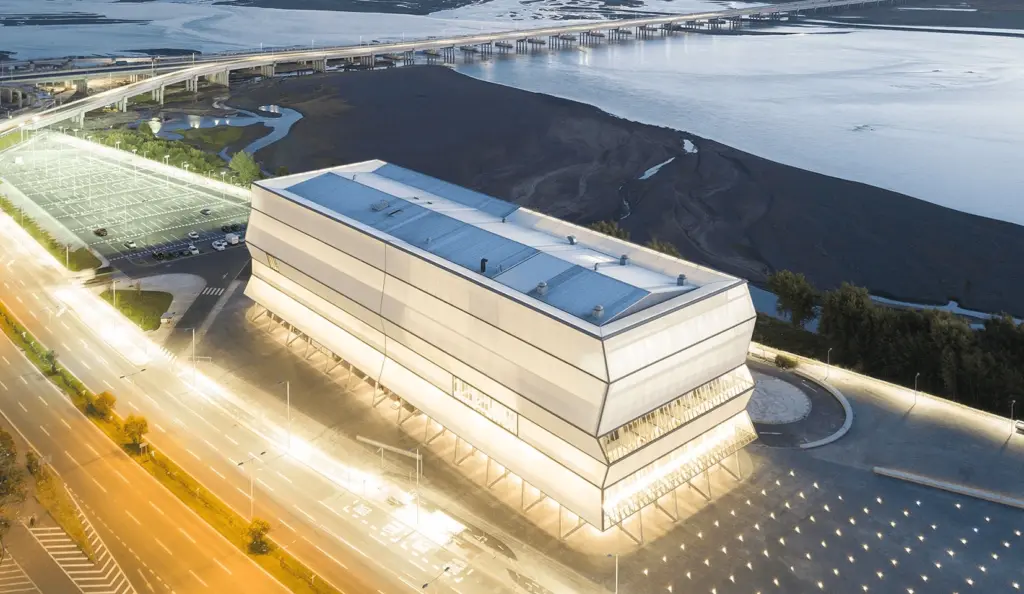
The 10,000-square-meter building features two performance halls, offices, and creative spaces. In contrast to a cultural landscape historically concentrated in the capital, Teatro Biobío has promoted a decentralized programming model, the creation of local content for international distribution, artist residencies, and TBB Lab—a laboratory for theatrical innovation made possible by the flexibility of its architecture. This includes a production workshop, lofts, and a coworking space managed by a specialized team.
Building on this model, Teatro Biobío joined forces with Teatro del Lago to co-produce Sebastián Errázuriz’s *Patagonia*, which was presented in Chile, Argentina, Spain, and Portugal. It also promotes exchanges with Spanish residency centers such as Nau Ivanow and Espacio Inestable, which foster creative work and expand international networks.
Cultural spaces are engines of social and economic development and drivers of identity and well-being. Exporting artistic content and cultural services is a way to share aesthetics and worldviews with the world; it is a way to contribute to the construction of human meaning in an automated world. Radić’s recent Pritzker Prize is an example of all of the above and reaffirms the international path that the architecture charted for the Biobío Theater.