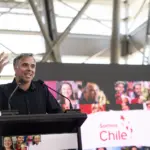
There is music that transcends borders and, at the same time, remains deeply rooted in the place from which it comes. Over the course of more than six decades, Los Jaivas have developed a sound that fuses electric instruments with sounds and rhythms rooted in Latin American traditions, incorporating elements that directly reflect Chile’s territory and identity. Their international tour has taken them to perform in places as diverse as Machu Picchu and Antarctica, as well as various countries in Europe and the Americas.
In this interview, Claudio Parra and his niece Juanita Parra—both members of Los Jaivas—discuss their relationship with Chile, from the sounds and instruments they identify as their own to the landscape, traditions, and the experience of building a community far from Chile.
With more than six decades of experience, you have brought Chilean music to stages around the world. What has it meant to you to represent Chile through your music?
Claudio Parra: It’s something that ultimately happens unintentionally. We didn’t set out to represent Chile; we simply make the music we make, and we’ve realized—based on the audience’s response to us—that we’re representing Chile and Latin America. We use rhythms that are native to this place, to this land, as well as certain types of chords and harmonies. The instrumentation is also quite unique because it’s not the typical setup of a folk group, for example, nor that of a rock band.
Juanita Parra: It’s really wonderful to be able to blend such unique instruments—like electric instruments—with traditional Latin American folk instruments. It’s nice to see how people connect with the music we make; it feels a bit like they’re in Chile even when we’re playing, say, in Norway, and they can sense that Chilean spirit through the music.
Is there anything about Chile—something that defines its identity—that you've always felt the need to showcase when you're abroad?
CP: The trutrucas is something that always surprises everyone—hearing this instrument and seeing how it's played.
JP: Yes, during the years when the group took on a school project to bring music to small classes of children in schools across France, the trutruca was the instrument that drew the most attention. It’s wonderful to be able to talk about the Mapuche people and play that instrument anywhere in the world. It gives great meaning to what we do.
What does it mean to you to be Chilean?
CP: I had never really thought about what it means to be Chilean, but I’ve gradually come to realize a few things. For example, our relationship with the landscape—because Chile is a country full of mountains and hills; no matter where you go, there are hills. And I think that’s what makes us the way we are—it’s hard for us to get to the bottom of things. We mull things over a lot because we have to cross the hills, and you never know what’s on the other side.
JP: Something incredible happened to me because I left Chile on this family musical pilgrimage. I was two and a half years old, and when I was 26, I decided to come back to Chile. I decided to come with a one-way ticket, settle down here, and I haven’t left since. I’ve been living in Chile for 30 years now. So, even I can’t quite pinpoint exactly what that “Chilean identity” is that made me feel I had to be here—that this was my home—even though I was raised and educated outside the country. I learned to read and write in French, for example. But it was the band’s music that gave me that connection to this land—the one I wanted to return to, despite all the years I’d spent away. And I’m happy to be here; I feel very Chilean.
CP: We had a special experience when we left Chile. We lived as a community—the whole group, including all the families, women, children, and even the coaches. So, since we were all living under one roof, we kept up many food traditions. Especially when it rained, we had to make sopaipillas and other traditional dishes.
If you had to describe Chile using a song by Los Jaivas, which one would you choose and why?
CP: “La quebrada del ají” because, in fact, the place is very Chilean, and the way it’s described in the song also draws on many elements of Chilean identity. I think that’s a good song. Plus, it’s in a cueca rhythm.
JP: Exactly. And it’s a song with a lot of power—just like us—the band’s music is so earthy. But it’s so nice that I’d thought of that same song, because it really does feel very Chilean, and at our recent concerts, when we play it, it creates an incredible energy.
CP: Another song that has a different meaning, but makes me think of Chile, is “La Conquistada,” because of its lyrics. It’s about something you remember, miss, and long for. It could be a partner, but it could also be the country, the homeland. And a lot of people interpret it that way. It’s also in a cueca rhythm—a slower cueca.
And when you play those songs outside of Chile, how is your music received?
CP: The rhythm of the cueca always catches your attention because it’s kind of off-beat; it’s hard to follow for someone who hasn’t grown up with it. That’s why I think it stands out.
JP: I would sometimes overhear conversations—like in the restrooms, without the audience realizing I was there—that all these tours by Chilean groups abroad are a time of communion—if you’ll pardon the redundancy—for the Chilean community and also for the families they’ve formed, since they’re mixed, with people from each country. So, I feel that these gatherings become a celebration of Chilean identity, and people really enjoy them because they’re the moments when they build community.
What do you think Chile has to offer the world in terms of culture and music?
CP: I would say that the poetry of our country and its poets, as well as Chilean music, make a significant contribution to society. Chile continues to be a land of artists. New generations continue to emerge in all the arts, and there is a large community that understands the importance of culture in a country’s development.
JP: I’ve come to realize that in Chile, the cueca was the only truly Chilean music. When we were just starting out, we wanted to draw on something, and that was the cueca, but the groups that played cueca were very folkloric, very traditional. Music from the north, for example, was practically unknown. And it was the groups of our generation—Inti-Illimani, Quilapayún—who adopted rhythms from other places. One that comes up a lot, which even we ourselves have used, is the joropo. And Chilean songs have been made using these rhythms; in other words, we’ve adopted rhythms from other places, but we’ve made them our own, and that’s how they’re perceived today.
You lived outside of Chile, either as part of the band or as part of the Los Jaivas community abroad. What was it like to make a home in another country, and how did you stay connected to your Chilean roots?
JP: I think that living in a community and maintaining musical traditions made those of us who were born in that community—who lived there, even though we attended school in France, in this case—feel deeply Chilean. And that can only be because of what our families passed on to us, because I wouldn’t have been able to feel Chilean if it weren’t for my family making me feel that we were Chilean. We celebrated the 18th, held contests, and there was also a strong connection through Chilean culinary traditions. So, that family—making music and talking about this land, even though we were thousands of kilometers away—was the way they helped us understand that we belonged to something, that we had an identity. And I can say that I am proof of that.