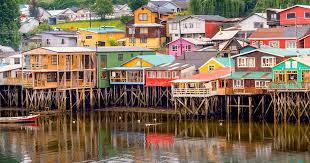


The stilt houses of Chiloé are one of the most iconic sights in southern Chile. These homes, built on wooden stilts, represent the adaptation of Chiloé’s communities to a maritime environment, becoming a living symbol of their cultural identity.
Located mainly in Castro, the archipelago’s capital, the stilt houses of Chiloé stand out for their vibrant colors and their direct connection to the tides, blending harmoniously into the natural landscape of southern Chile.
Architecture by the Sea: Adapting to the Chilote Environment
The stilt houses of Chiloé are built with sturdy wood and raised on stilts that extend into the shoreline. This technique allows residents to adapt to tidal fluctuations and have direct access to the sea.
Traditionally, many of these homes have been associated with fishing families, who take advantage of their proximity to the water to engage in activities such as fishing and shellfish gathering. Furthermore, their design provides protection from the rainy and cold climate characteristic of the area, demonstrating a functional architecture adapted to the local environment.
The History and Cultural Significance of the Stilt Houses of Chiloé
Since the 19th century, the stilt houses of Chiloé have been a fundamental part of life in the Chiloé archipelago. Their construction was a response to the need to make use of coastal space and facilitate access to the sea, a central element of Chiloé culture.
During the 20th century, many of these settlements faced demolition. However, over time they have been reevaluated as cultural heritage, recognizing their historical, social, and architectural importance within Chile.
A must-see tourist attraction in southern Chile
Today, the stilt houses of Chiloé have established themselves as one of the main tourist attractions in southern Chile. Many have been restored and converted into boutique hotels, restaurants, and cultural venues, offering unique experiences to both domestic and international visitors.
Exploring these neighborhoods offers a firsthand look at a way of life deeply connected to the sea, where architecture and culture blend together naturally.
Why visit the stilt houses of Chiloé?
Visiting the stilt houses of Chiloé is an opportunity to discover a style of architecture unique to Chile, one that reflects the archipelago’s identity and history. It also offers an authentic tourist experience, where traditions, cuisine, and landscapes characteristic of southern Chile come together.
The Chiloé archipelago also offers other attractions, such as its historic churches, local cuisine, and rich biodiversity, establishing itself as a comprehensive destination for cultural and nature tourism.
The Stilt Houses of Chiloé: Chile's Living Heritage
More than just colorful structures, the stilt houses of Chiloé reflect a community that has successfully adapted to its environment and preserved its traditions over time.
Today, they stand as a symbol of Chilean cultural heritage and an invitation to discover a way of life where architecture, history, and the sea intertwine in a unique way.