While Chiloé is famous for its green landscapes and mist-covered canals, it is also known for having a rich world of legends and myths that cross generations. Its inhabitants have passed down stories that mix the magical with the everyday, populated by fantastic creatures and secrets of the sea and forests, forming a unique imaginary that continues to fascinate those who travel these islands.
Among the stories that inhabit the archipelago, some stand out for their symbolic strength and attachment to Chiloé life. They also reveal a different aspect of the relationship between the people and their environment: the sea, the forest and the waters surrounding the island.
La Pincoya
The Pincoya is perhaps one of the most beloved figures of Chiloé mythology. She represents the fertility and abundance of the sea. She is described as a young woman of extraordinary beauty, dressed in seaweed, who emerges from the depths to dance on the shore. Her dance is an omen: when she dances facing the sea, the waters will be bountiful and the fish will abound. But if she dances facing the land, the fishermen know that hard times are ahead and the catch will be scarce.
Her figure reflects the deep bond that the people of Chiloé maintain with the sea. Unlike other mythical beings of the archipelago, she does not inspire fear, but respect and gratitude. She is the protector of sailors, who depend on fishing.
El Trauco
It is said that the Trauco is a small being, of hard aspect and deformed face, that inhabits the humid forests of the archipelago. He usually wears clothes made of moss and a hat made of bark. Despite his appearance, he possesses an overwhelming charm. It is said that no woman can resist his gaze and it is enough for the Trauco to look at her to cast a spell on her.
It is considered a spirit of nature, but also a being that arouses fear and respect. In the towns of Chiloé, it was often said that unexplained pregnancies were "the work of the Trauco", thus becoming a figure that mixes the magical and the social within the Chiloé tradition.
El Caleuche
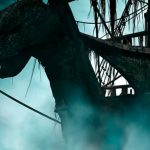
Also known as a ghost ship, it is described as a burning ship with three masts and many lights, which appears and disappears among the waves along with the music that sounds incessantly. Manned by witches and enchanted sailors, the Caleuche sails in the dark nights and is often camouflaged as a simple floating timber and its crewmen as sea lions or waterfowl. It is said that it collects the souls of sailors who die at sea, taking them to live forever in its depths.
The Caleuche symbolizes respect and fear towards the forces of nature, as well as the belief in an invisible world that coexists with ours, reminding us that in the archipelago, each wave can hide a secret and a story to tell.
El Camahueto
The Camahueto is one of the most powerful and enigmatic creatures in the mythology of Chiloé, in southern Chile. It emerges from the depths of the earth in the form of a green calf with a single horn on its forehead. Its stride is so powerful that it sweeps away trees and rocks until it reaches the ocean, where it completes its life cycle. According to tradition, the machis wait for its appearance to capture it and obtain its horn, whose shavings are considered a remedy capable of curing illnesses.
This creature embodies the boundless energy of Chilote nature and the close bond between the archipelago’s inhabitants and their environment. This legend from southern Chile expresses the belief in a living, fertile, and powerful land, where every natural phenomenon is inhabited by a spirit that explains its existence.
The Witches of Chiloé
The Brujos de Chiloé were a secret society that combined indigenous and European knowledge to practice magic and healing. It is said that they could fly, transform themselves into animals and know the secrets of plants, although they had weaknesses such as salt or canelo smoke. Beyond their powers, sorcerers played an important social role, resolving conflicts and settling ancestral traditions.
Its history, which achieved notoriety with the 1880 trial, reflects how in Chiloé the magical and the communitarian are intertwined, forming part of the cultural identity of the archipelago.
The legends of Chiloé are a reflection of its collective identity, a living heritage that connects generations and gives meaning to the territory. In them, nature, spirituality and imagination intertwine to form a unique worldview. To preserve and share them is to keep the voice of the archipelago alive in Chile's cultural memory.