

On the afternoon of Wednesday, May 6, amid sustained applause from the audience, “Inter-Reality,” the Chilean Pavilion at the 61st Venice Biennale, was officially inaugurated. The exhibition, created by artist Norton Maza, was co-curated by Marisa Caichiolo and Dermis León, with Claudia Pertuzé serving as project manager. The Chilean contribution is a large-scale, multisensory immersive installation that plays with illusion, simulation, and perspectives, articulating a complex perceptual field that challenges the viewer’s point of view. It also addresses issues such as migration, the ecological crisis, geopolitical conflicts, misinformation, and political tensions.
“I am happy and excited to represent Chile at such an important international event as this. It took months of intense work alongside a great interdisciplinary team that supported me from the very beginning of this project, and to whom I am deeply grateful,” said artist Norton Maza, who added:“Inter-Reality is a contemporary and timely artistic project that isn’t just about Chile, but about situations that are happening—or could happen—in different parts of the world, so viewers will surely find what they see resonant.”
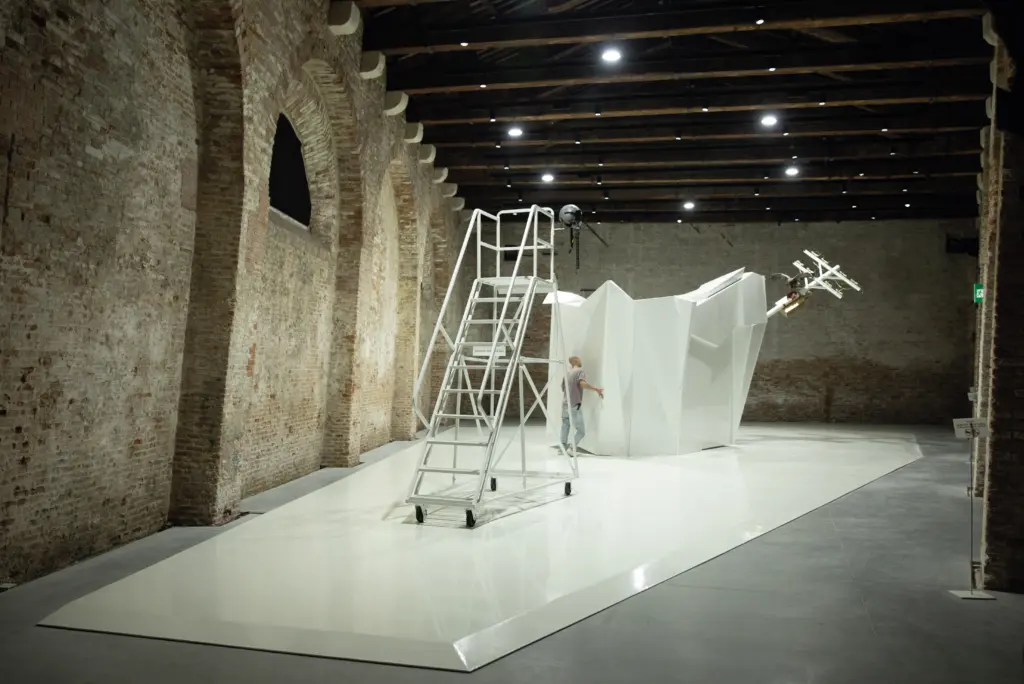
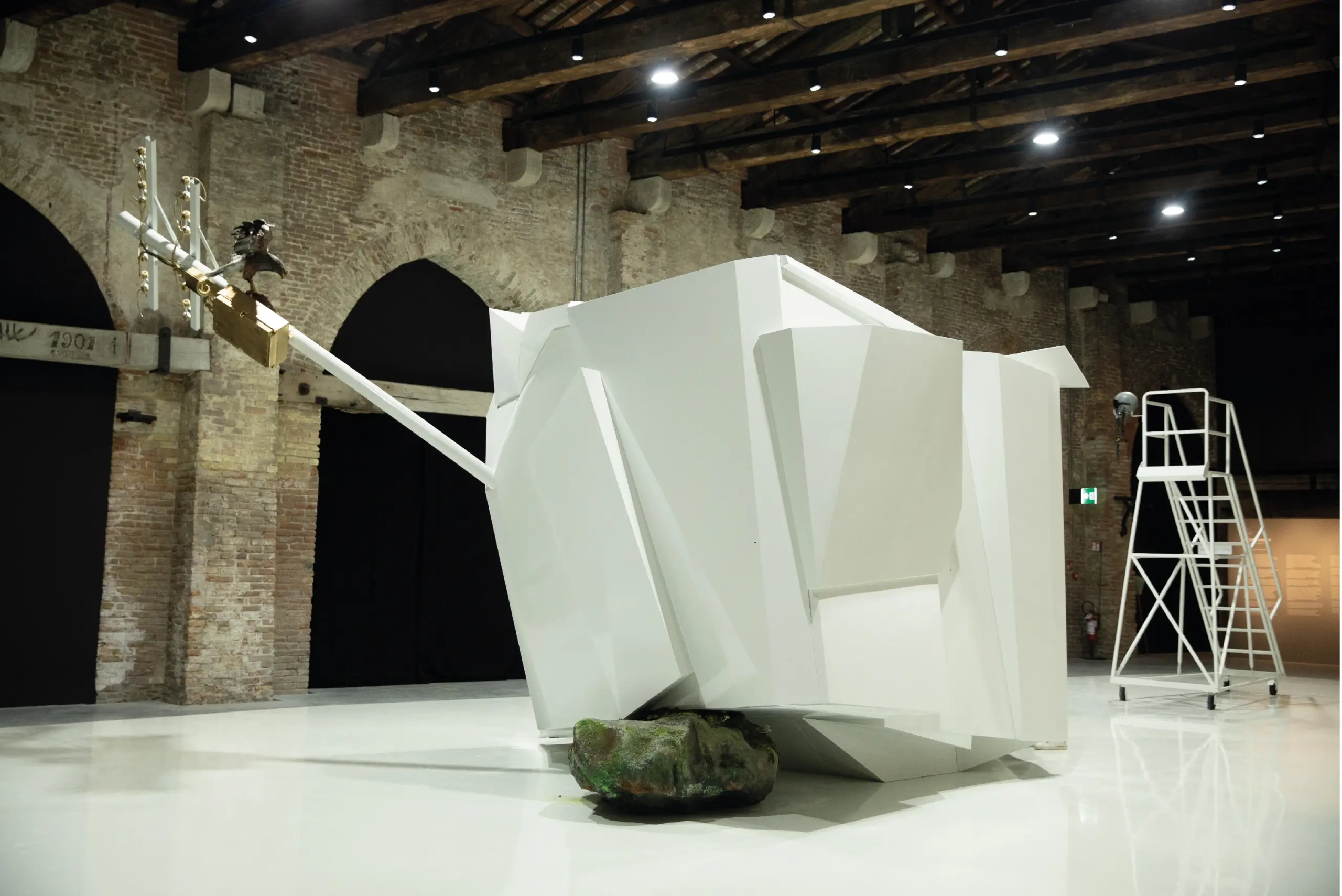
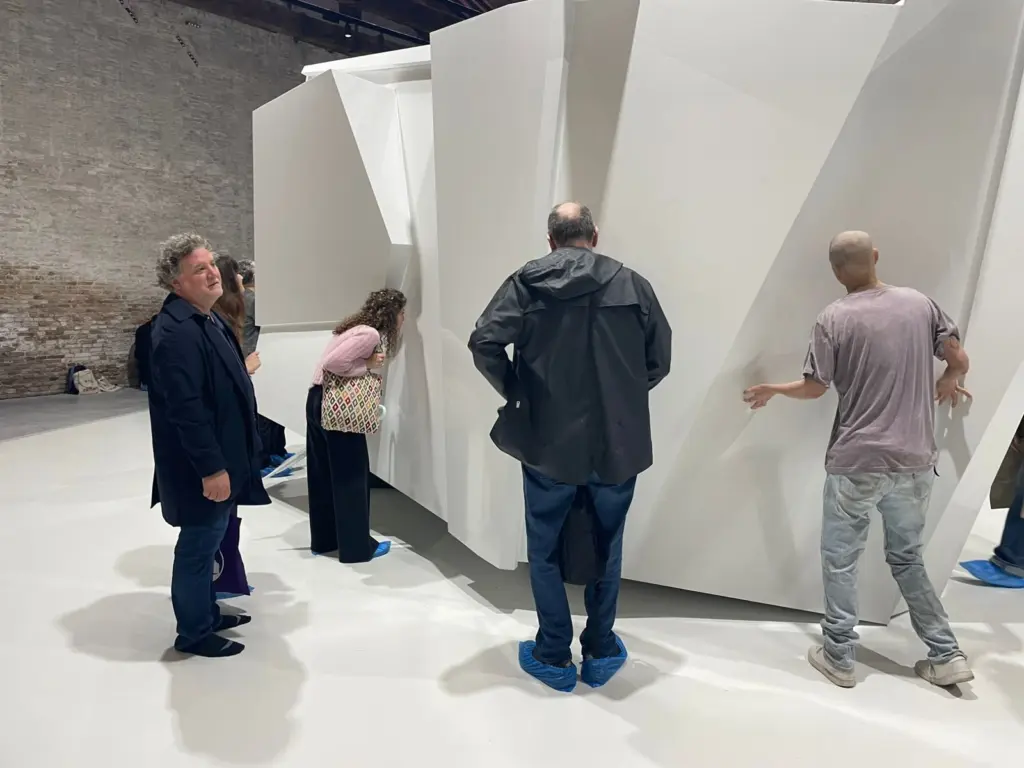
Upon entering the room, visitors will see a large-scale architectural structure—perched on a rock—from which an electric pole with gold-plated generators emerges, and on which a Harris’s hawk (a bird of prey) is perched. Meanwhile, through four small circular viewing windows, they can look inside and see dioramas of classic landscapes accompanied by movement and sound. The installation is complemented by a human figure, a boarding ladder, and a fighter pilot’s helmet, which guide the viewer toward alternative viewpoints of the centerpiece. All these components invite reflection on memory, civic responsibility, and the interrelationship between power, truth, and freedom.
Inter-Reality creates a space for critical, ethical, and collective dialogue, exemplifying the artist’s collaborative practice through the integration of original music, advanced technologies, and hyperrealistic elements.
Florencia Loewenthal, Executive Secretary for Visual Arts at the Ministry of Culture and curator of the project, attended the opening. Also present were Paola Palma, chief advisor to the Ministry of Foreign Affairs and chargé d’affaires at the Chilean Embassy in Italy; Daniela Aravena, head of the Visual Arts and Architecture Division at DIRAC; Andrea Pacheco González, a member of the jury that selected this project to represent Chile; as well as a number of artists, gallery owners, and national and international correspondents. Meanwhile, throughout the day, the Pavilion received a total of 5,200 visitors.
“Today we are inaugurating the Chilean Pavilion at the Biennale, which returns to the Sala dell’Isolotto, one of the most significant and well-attended venues within the Biennale. Chile’s participation is made possible by a major inter-ministerial effort, which presents a challenge given the unique characteristics of the city of Venice and the demands of remote work. Seeing it live and in person, I can reaffirm the undeniable visual and reflective power of Norton Maza’s work,” emphasized Florencia Loewenthal, executive secretary of Artes de la Visualidad.
Chile’s participation in the 61st Venice Biennale of Art is the result of an inter-institutional collaboration between the Ministry of Culture, Arts, and Heritage—through its Executive Secretariat for Visual Arts—and the Ministry of Foreign Affairs—through the Division of Culture, Arts, Heritage, and Public Diplomacy (DIRAC)—in conjunction with the Chilean Embassy in Italy. This project is also made possible thanks to the sponsorship of Insesa Ingeniería y Servicios; Building Bridges Art Foundation, Pacífico Research, Inmobiliaria Paz, and OGZero.