From a young age, Constanza Escobar was interested in mathematics, physics, and chemistry, to the point of competing in academic competitions in those subjects. That passion led her to study Chemical Engineering at the University of Chile and, years later, to become a co-founder and Chief Science Officer of Photio, a science- and technology-based startup that is developing an additive capable of transforming various materials into surfaces that help purify the air.
The technology, based on nanotechnology and photocatalysis, can be incorporated into materials such as paint, concrete, and asphalt, and there are already products on the market and applications that have been validated on roads. “We’re pioneers, which also brings its own set of challenges, and people often question us: ‘How is it that we in Chile are doing something so unique?’ A lot of the time, they don’t believe us,” says Escobar.
In this interview, Constanza discusses the path to entrepreneurship in science, the barriers that still exist for women, and her vision for the potential of Chilean talent to create solutions with global impact.
How did your interest in science begin?
It started when I was very young. I’ve always really liked math, physics, and biology. I participated in math and chemistry competitions. Studying was my favorite pastime; in fact, my mom used to scold me because I studied so much. Eventually, I decided to study something related to math and enrolled in the School of Engineering at the University of Chile; however, I realized that my interest in science was still there, so I decided to study Chemical Engineering.
What motivated you to create Photio, and what was your journey like as an entrepreneur in the field of science?
Together with Jaime and Matías, the other co-founders of Photio, we were looking to solve the problem of pollution at mining sites. It’s a problem that currently exists in Chile because there’s so much pollution; in fact, operations often have to be halted because workers cannot be exposed to such high concentrations. So, in our search for a solution to this problem, we created Photio, a startup where we developed an additive that can be incorporated primarily into building materials, transforming these materials into air purifiers. The additive uses nanoparticles that harness solar radiation or artificial light as energy to carry out a process similar to the photosynthesis performed by plants. We already have two products on the market.
Is there any competition for the work you do in the domestic or international market?
There are other technologies similar to what we do that are based on different principles; they aren’t the same as what’s behind Photio, which is photocatalysis. But the business model we’re implementing is different from any other currently being developed worldwide. And in that sense, we’re pioneers—which, in turn, brings its own challenges, and people often question us: “How can we in Chile be doing something so unique?” People often don’t believe us. In fact, they ask us, “Hey, where do you get this from?” or “Is this from the United States?” And it’s hard for them to believe that we’re the ones manufacturing this additive in Chile and exporting it. So, the fact that there aren’t many competitors is a challenge, because we have to blaze this trail all on our own—there’s no one else to look to for guidance—but on the other hand, we realize that we’re clearly doing something unique.
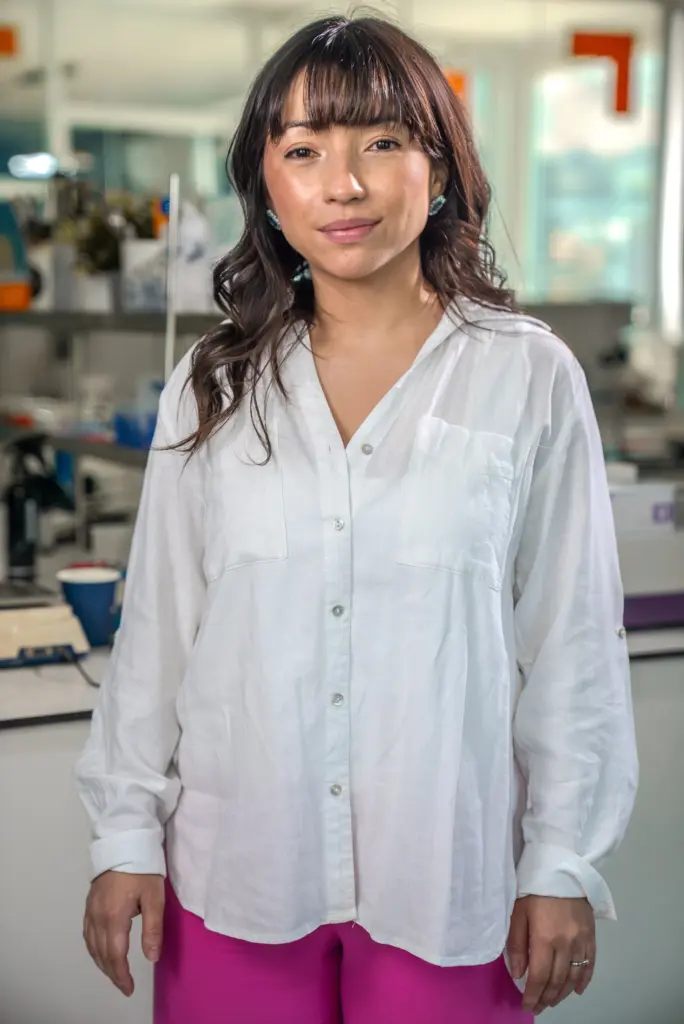
Has it been very challenging for you, as a woman, to pursue a career in science?
The truth is that I’ve done well ever since I was in school. In my case, my parents always encouraged me a lot to study and to always be the best. So, in that sense, it was never a challenge for me. Plus, I was lucky enough to attend an all-girls school, the Liceo Carmela Carvajal, where everyone was brilliant. Then, once in college and in the workforce, you start to realize the gaps that exist, that things get a little more complicated, and that it’s harder for women to get certain positions.
Leaders in Development
Beyond the development of Photio, Constanza Escobar reflects on the role Chile is playing in innovation with a global reach and on the resilience that, in her view, sets Chilean women apart. Along the way, she also acknowledges those who have paved the way before her. “In the world of innovation in Chile, there are many inspiring women. Alejandra Mustakis has been a role model for me,” she said.
How do you think American talent is contributing to the world?
I believe that Chile is developing a lot of technology from this corner of the world, and there are many startups with export potential. With Photio, we’re bringing technology to different parts of the world through various partners. In addition, there’s a lot of support from different institutions—such as Corfo, for example—which provides significant assistance in scaling these solutions. I think we’re on the right track, and obviously there’s a need for greater access to financing and gaps to bridge, but I do believe that exportable solutions and startups are indeed being developed.
What does it mean to you to be a Chilean woman?
For me, being a Chilean woman means being able to overcome the various adversities that may arise along the way. Resilience is key for Chilean women—for all working women, for the scientists who keep their homes, families, and businesses running. I believe that is key and what defines Chilean women.