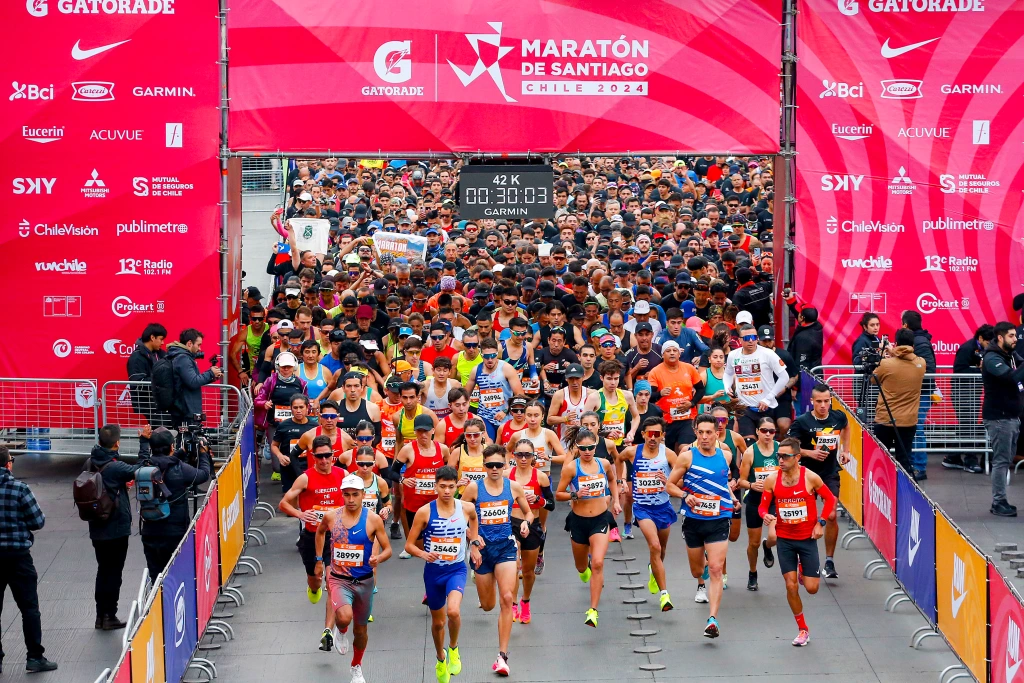


This Sunday, April 26, starting at 7:40 a.m. in front of La Moneda Palace, the 19th edition of the Santiago Marathon will kick off. It is the country’s most important and popular running event, with an estimated 35,000 participants competing in the 10K, 21K, and 42K races.
The event also features Paralympic athletes as a central part of the program; they compete on the same course but with separate starts, ensuring appropriate conditions for the competition.
The race is certified by World Athletics and is part of the international marathon circuit, allowing runners to qualify for global rankings, including world championships and the Olympic Games. This year’s event will also feature participants from 42 countries. This status places Santiago on the international running calendar and enhances its appeal to elite athletes.
Santiago in the spotlight of the international running scene
Runners from countries such as Kenya, Ethiopia, and Peru will be competing in Santiago, raising the bar for the competition and projecting the race beyond local borders. In recent years, the Santiago Marathon has attracted top-tier athletes with international-level records, increasing its visibility on the South American circuit.
The event puts not only the athletes to the test, but the city as well. Traffic closures, security deployments, transportation arrangements, and operational coordination transform Santiago into a massive racecourse, on a day that mobilizes thousands of people both along the route and beyond.
Francisca Aguirre, Executive Director of the Marathon, said: “This event has established itself as Chile’s most important sporting event. Currently, our goal is to strongly promote it abroad, reaching markets in Latin America and Europe to continue increasing the number of runners. It’s exciting to see how far we’ve come: we went from having between 400 and 600 marathoners in our first edition to the 8,000 who run today.”
Career-defining moments
The marathon attracts not only elite athletes but also people who have overcome major obstacles in their lives. Such is the case with Rodolfo Sánchez, an athlete who will be running the 42K for the second time: “Running the Santiago Marathon is always an incredibly rewarding experience. This is my second 42K, and my biggest motivation is my son Rafael, who is two and a half years old. He loves watching his dad compete, whether in a wheelchair or running; he’s my main driving force. I want him to feel proud, to see me participate, and to cherish these beautiful memories of a father.”
For her part, Camila Delpiano, who has cystic fibrosis and underwent a double lung transplant a few years ago, sees running as a lifestyle she will never give up: “Running a marathon is a way of proving to yourself that you’re alive—that you’re so alive you can challenge yourself and overcome that version of yourself who was afraid, who didn’t know she could do it but gave it a try. I understood that the moment I stepped out onto the street and did it. And the fact that they give you a medal for that effort is priceless.”
A partnership to promote the country
In the run-up to the race, the Santiago Marathon and Marca Chile signed a partnership agreement aimed at expanding the event’s international reach, leveraging its visibility to promote the image of a country that supports sports and is ready to host large-scale events.
Enzo Abbagliati, acting executive director of Marca Chile, stated after the signing: “This agreement between Marca Chile and the Santiago Marathon aims to enhance our country’s image through sports. The objective can be summarized in three main areas: consolidating Chile as a powerhouse in world-class events, promoting Santiago as a cultural and gastronomic capital, and projecting values such as healthy living and resilience—a hallmark that identifies us as Chileans both on the road and to the world.”
In this way, the Santiago Marathon becomes an opportunity to showcase Chile on the international stage: its sporting significance, its reach, and the images of the city—with the Andes Mountains in the background—reinforce Santiago’s standing in the world.