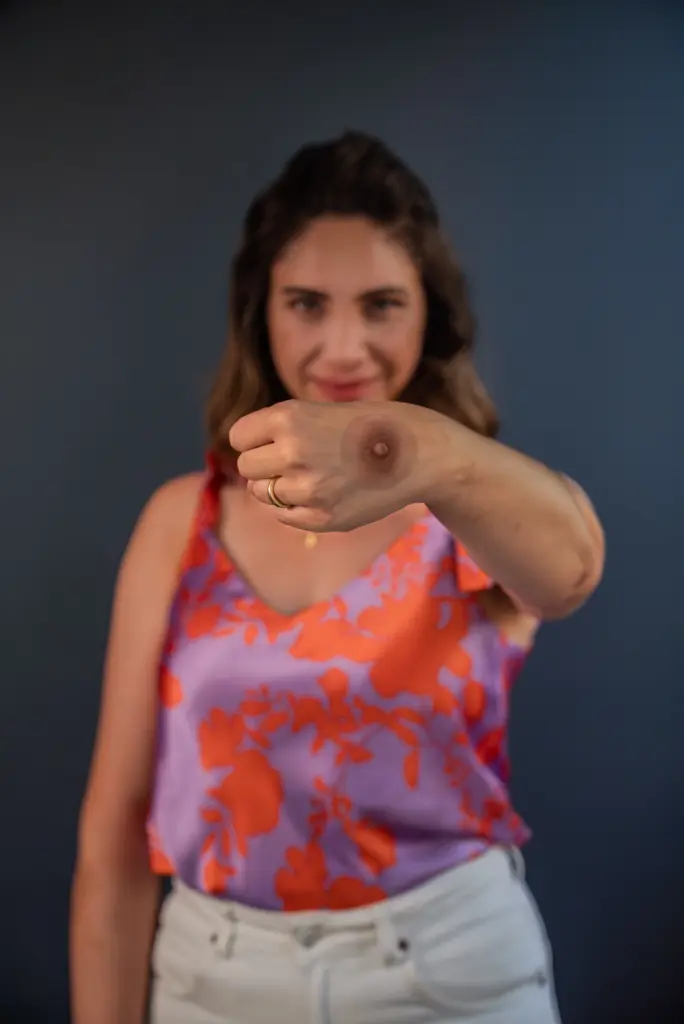
Drawing on a personal experience marked by resilience and the search for new ways to reconnect with her own self-image, Beatriz Palma created My Nipp, an initiative that aims to support women who have undergone a mastectomy by providing solutions for the external reconstruction of the nipple-areola complex. These are custom, hand-painted prostheses that are specifically tailored to each individual’s body.
“A woman who feels comfortable in her own skin can take on the world,” says Palma. With more than 400 users in Chile and the challenge of expanding her model to other Latin American countries, the entrepreneur is part of a generation of women who are driving solutions that make a difference.
How did My Nipp come about?
I’d say that My Nipp stems primarily from a debt we owe to breast cancer survivors. Today in Latin America, only one in 10 women who undergo a mastectomy have access to reconstruction of their nipple-areola complex. They can often access breast reconstruction—to restore volume—but the nipple-areola complex, that part of our body, is left out of the equation. And often this is due to lack of access, or because women don’t want to undergo more surgeries. The current alternatives are expensive, invasive, and women are very tired of the pain. Cancer brings a lot of uncertainty and a lot of pain, and we have a responsibility to address that pain—to help these women feel at home in their bodies again and regain a strong sense of self-esteem. That’s where My Nipp comes in.
How does My Nipp contribute to Chilean women's self-esteem and well-being?
At first, I always described My Nipp as external prostheses for the areola-nipple complex for women who have undergone a mastectomy. Today, that narrative has changed, and I describe it as an ecosystem where we talk about the product, where we talk about purpose, and where we talk about community. Sometimes My Nipp is a conversation, or it’s about helping a woman look at herself in the mirror again. It’s simply about being there for her without judgment. In Chile, we often emphasize being grateful that you’re alive, that you’re cancer-free, and that you need to move forward and reintegrate into life. But you’re not the same person anymore, so you have to work on rediscovering yourself, because you’re never going to be the same again.
You've said that your mission is to make My Nipp accessible to all women. How do you plan to achieve this on a global scale?
Helping My Nipp expand internationally is one of my biggest challenges. To do that, we’ve realized we need to train local facilitators who can implement our system while understanding local nuances, so that we can provide this support—which is truly essential and serves as the foundation for women to use our solution. That’s why we’re scaling up in Latin America first. That’s why we created My Nipp Academy—because I can’t replicate myself, but we can find people locally who can do this work, build a community, and make the prostheses.
“We are the driving force, the power”
How do you think your work positively impacts women in Chile?
Today, we have more than 400 Chilean users who have used our solution and told us it changed their lives. Today, they’re able to look at themselves with more love, to be at peace with their bodies in a kinder way—and ultimately, that’s what holistic healing is all about. Women around the world are the driving force; we’re the strength; we’re often the ones who keep our families going. And if that’s missing, everything falls apart. An emotionally healthy woman—a woman who’s at peace with her body—is a woman capable of taking on the world.
Where does your passion for boosting women's self-image and confidence come from?
It stems from a personal story of resilience. I’ve had 11 surgeries on my nose and mouth. I was born with a cleft palate, and makeup was my defense mechanism. Learning to recognize that as a response that strengthened me—that helped me bring out more of my personality—means acknowledging that something external can help. And I’ve applied that insight to the various things I’ve done in life. I believe there’s tremendous work to be done to empower them—to help them see themselves in a new light and to respect their differences, their own pace, and their own ways.
Seeing how your work has impacted the lives of others, do you think Chilean women today are leading changes that empower others?
Absolutely. Today, I believe that the work Chilean women are doing is rooted in empathy and in analyzing real needs, and they’re bringing about profound changes in society—changes that affect not only women but our entire community. I think it’s very important to always start by looking in the mirror, and when we’re doing well, we have a ripple effect. I feel that Chilean women have a superpower: when we come together, it’s as if no one can stop us. We’re tremendously powerful. We’re ready to take on the world.
Do you remember any stories from My Nipp that particularly stood out to you?
Every woman is a world unto herself, but I don’t think I’ll ever forget one of my first patients who told me, “It’s not that I’ll ever be the same again—it’s that now I’m whole.” She later explained to me that she now truly had permission to live, permission to be herself. Now she can say she feels whole in every aspect of her life. That first patient also made a huge impact on me, because I had simply gone to fit her with a prosthesis, but that prosthesis opened a Pandora’s box—emotions poured out, tears flowed—and you gradually realize and say, “Wow, I didn’t know I was going to face this.” And then when she told me that her little daughter saw her in the shower and said, “Mom, you’re finally better—your nipple has grown back,” my heart and soul were overwhelmed. I understood how this can affect people on so many levels.