I feel a tremendous pride of being Mapuche, of being Chilean, of having been able to position Chile in one of the pavilions of the Expo Osaka surely with more sense.
After six months of operation, Expo Osaka 2025 closed on October 13, in which Chile participated with a pavilion and a country story divided into thematic weeks. On the eve of the closing, the International Exhibitions Bureau, the organizing entity of the Universal Expos, distinguished Chile with the bronze medal in the category "Thematic Development", which highlights the narrative and conceptual quality of the national proposal, which contained the "Makün: The Mantle of Chile".
It is a 242-square-meter sheep's wool mantle, woven by 200 craftswomen from the Bío Bío and Araucanía regions.
Anita Paillamil is the Mapuche artisan who led its creation. With nearly 30 years of experience in the textile industry, Paillamil has been internationally recognized for her work. "Today we, the artisans who participated in the construction of the Makün, feel a gigantic joy, because it is recognized, on the other side of the world, that the handmade work of indigenous cultures, by indigenous peoples, has an unimaginable value," says Paillamil about the recognition of the mantle in Japan.
What does it mean to you that the Manto de Chile is the work that received visitors from all over the world in the Chile Pavilion at Expo Osaka?
I feel tremendously proud to be Mapuche, to be Chilean, to have been able to position Chile in one of the pavilions of the Expo Osaka , surely with more meaning. I think the cultural sense that we gave to the pavilion was very close to the Japanese public and I feel that it is a very important milestone for all of us who participated in the construction of the pavilion and also for each of the delegations that were able to make their thematic weeks. I feel that the Osaka team also gave 100% to put together a wonderful agenda that made the public happy. For me personally, it was the greatest thing to have been able to participate in this construction, to be able to make my culture visible, to be able to show Chile, the richness it has in terms of tourism services and exportable products.
How do you receive the award obtained by the Makün and the work of so many craftswomen who were part of this work?
Regarding the recognition received at Expo Osaka, I feel that it demonstrates that the textile weavers, in general, the women who weave, have the capacity to work in groups, in an associative manner, and that it shows that this works, that working in a collaborative, associative way today leaves its mark. I believe this is a tremendous lesson for those who work or believe that by working independently they can achieve their objective. Today we, the craftswomen who participated in the construction, feel a gigantic joy, because it is recognized, on the other side of the world, that the work done by hand by indigenous cultures, by indigenous peoples, has an unimaginable value. It is a very important appreciation and an encouragement to give continuity to what we have been doing.
More than 200 weavers participated in its production. What was it like to lead that process?
For me, leading the work with 200 weavers was a gigantic challenge. I have the possibility of working for more than 30 years with women's groups and that has also meant that people recognize and validate my work.
On that occasion we sat down to work with the architect, where we were able to put together this proposal and then transfer the information to the weavers. It has its complexities, but it is also satisfying when such nice things happen as being able to travel to Japan and have our textiles there. It was a very interesting, challenging and fulfilling project. It was three months of intense work, where we bought the raw material, worked on the distribution of the wool, went to the communities, went to the groups, gave the technical specifications to the representative, etc. In other words, the actual production of the textiles may have taken three months, but the work in the field, transferring the information, making a review and the prototypes, took about six months.
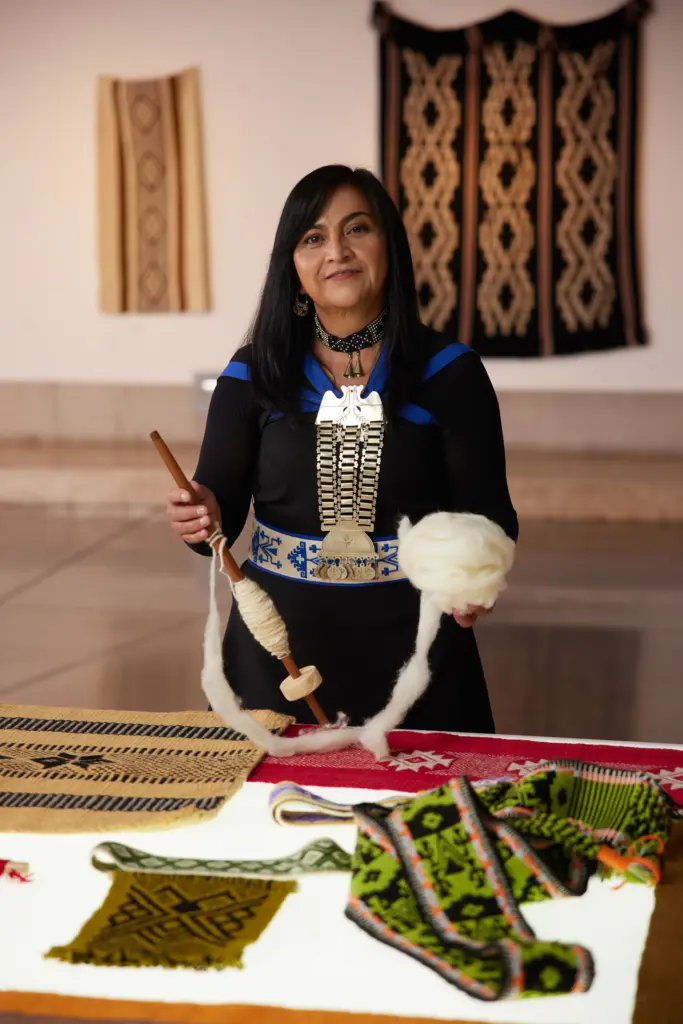
You have received recognition in Chile and abroad, including recently in Carolina Herrera's Women in the Arts program. What do these awards represent for you in your career?
I feel that these are recognitions for more than 30 years of work leading groups, being a leader, being a textile company. It also has to do with perseverance and the fact that I have dared to take on many challenges.
The Women in the Arts program with Carolina Herrera was an unexpected experience for me, because I never thought that a giant brand like this would set its eyes on my work. And I am happy, grateful for life, for having dared, grateful for my family that has always supported me, grateful for the groups with which I currently work, with Wallontu Witral, the group that I formed more or less 25 years ago, of which I am very proud.
For me these recognitions are an injection of energy. Also everything that people give through social networks, like recognizing the work that one has been doing. I have dared and broken barriers. It has not been easy. It's been years of work and I think that somehow what I do is valued.
How do you think your work and that of the Mapuche craftswomen project Chile internationally?
I have had the opportunity to travel a lot outside of Chile and get to know different markets, but it is difficult for others to see it as well. Many people do not believe in these possibilities, they see it as something unattainable, they see it as something complex, that the resources are not there. But I plan, and I have been talking about it for a long time with institutions like Prochile, for example, that we can make visits to international fairs so that not only I, but also other women feel that there is a market outside Chile.