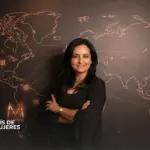


Alejandra Mustakis, Chilean businesswoman
We are a small country, far from the world’s major economic and cultural centers. But perhaps that is precisely why we have developed capabilities that are particularly valuable today.
In recent weeks, several Chileans have made a name for themselves around the world thanks to their talent in various fields. Chilean swimmer Bárbara Hernández became the first Latin American athlete to receive the Alison Streeter Award in England after completing a double crossing of the English Channel in 27 hours and 19 minutes of continuous swimming. Architect Smiljan Radić Clarke was awarded the 2026 Pritzker Prize—considered the Nobel Prize of architecture—an honor that recognizes those who have made significant contributions to the discipline on a global scale.
In the world of cinema, Chilean director Diego Céspedes made history by being selected as a member of the jury for the Official Competition at the 2026 Cannes Film Festival, thanks to the impact of his debut feature, *La misteriosa mirada del flamenco*. At the same festival, the short film *Para los contrincantes*, directed by Argentine filmmaker Federico Luis and produced by the Chilean company Planta, won the Palme d’Or for Best Short Film, becoming the first production with Chilean involvement to receive this honor.
What is striking about these stories is not only their magnitude, but also our reaction to them. Every time a Chilean excels abroad, the news is often treated as something improbable, almost anecdotal. We celebrate the achievement, but at the same time there seems to be a sense of constant surprise, as if international success were an exception rather than a real possibility.
However, when these cases occur time and time again in fields as diverse as sports, architecture, film, science, technology, and entrepreneurship, perhaps we are not dealing with isolated incidents. Perhaps we are observing a pattern that we have not yet fully recognized.
For decades, Chile has been producing extraordinary individuals in a wide variety of fields. In my view, this is not because we have more resources than other countries. Often, the opposite is true. We are a small country, far from the world’s major economic and cultural centers, with a limited domestic market and many challenges still ahead. But perhaps that is precisely why we have developed capabilities that are particularly valuable today.
There is something that rarely shows up in statistics or international rankings. We are used to doing a lot with very little. We are used to solving problems. To finding paths where there are none. To improvising when resources are scarce. To creating opportunities where others see only limitations. To competing through creativity rather than abundance.
While in many parts of the world projects move forward backed by massive budgets, huge teams, and highly developed ecosystems, in Chile we’ve learned to build amid uncertainty. We’ve learned to adapt, reinvent ourselves, and move forward even when conditions aren’t ideal. And although for years we saw that as a disadvantage, perhaps today it has become one of our greatest strengths.
The world is changing at an unprecedented pace. Artificial intelligence, automation, digital transformation, and social and environmental challenges are forcing individuals and organizations to constantly adapt. In this context, the most valuable skills are no longer necessarily the resources at hand, but rather the ability to learn quickly, collaborate, innovate, and create solutions in the face of uncertainty.

And we Chileans have plenty of experience with that.
That’s why, when I see stories like those of Bárbara Hernández, Smiljan Radić, or Diego Céspedes, I don’t see exceptions. I see signs. I see evidence of something that has been happening for some time: that from Chile, it is possible to build knowledge, culture, businesses, technology, and global impact. I see people who are capable of transforming an idea, a passion, or a conviction into projects that transcend borders and engage with the world.
I also see a tremendous opportunity for the younger generations. Because each of these examples broadens the horizons of what’s possible. It shows thousands of children, young people, and entrepreneurs that you don’t have to be born in a major world capital to build a career with international impact. That talent can emerge from anywhere when there’s perseverance, hard work, and purpose.
In my opinion, the time has come to recognize that we have extraordinary capabilities to compete on the world stage and to dare to play that game with greater ambition—not out of arrogance, but out of confidence—with the conviction that we can add value, create solutions, and lead initiatives that matter on a global scale.
Because one of our country’s greatest assets lies in the ingenuity, creativity, and ability of its people to transform what they have into something much greater. And that is a treasure we are only just beginning to discover.
Column originally published in El País.