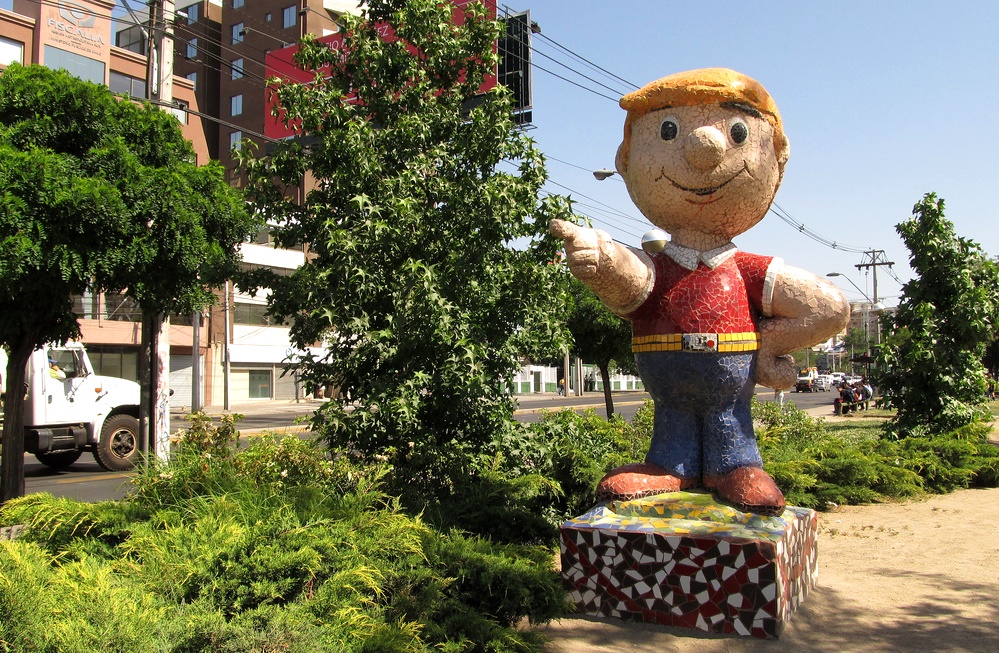


The Comic Park is a place that invites visitors to journey back to childhood and reconnect with some of the most iconic characters in Chilean comics. Through sculptures of figures such as Condorito, Mampato, and Pepe Antártico, this public space has become a tribute to popular culture and the history of Chilean comics.
History and Creation
Comic Park was inaugurated in 2006 by the Chilean sculptor Sammy Salvo and is located in the municipality of San Miguel, on Gran Avenida, between María Auxiliadora and Alcalde Pedro Alarcón streets.
The project features five sculptures created by Salvo, designed to pay tribute to Pedro Subercaseaux—known as Lustig—an Italian cartoonist who lived in San Miguel and created the character Federico Von Pilsener in 1906, considered one of the first Chilean comic strips. Here we tell you about this and other characters you’ll be able to see in the park.
Federico Von Pilsener
Federico Von Pilsener, also known as Professor Fritz, is one of the earliest characters in Chilean comics. This man with a white beard, glasses, and a European appearance was sent from Germany to study Chilean customs.
Created in 1906, the character starred in a series of comic strips accompanied by text and illustrations, in which he found himself in various situations alongside his dachshund, Dudelsackpfeifergeselle.
Condorito
Created by René Ríos Boettiger, known as Pepo, Condorito was first published on August 6, 1949. His popularity grew rapidly in Chile and throughout Latin America.
The character was created in response to Chile’s portrayal in Disney’s film Saludos Amigos. Pepo then created Condorito as a witty, playful character who resonated with ordinary Chileans.
In the park, in addition to the main sculpture, you can see tiles featuring more than 25 characters who accompany Condorito on his adventures, along with his inseparable dog Washington.
Mampato
Mampato is a young adventurer who travels through time and experiences all sorts of adventures alongside his friends Ogú, a prehistoric man, and Rena, a mutant from the 40th century with telepathic powers.
The comic was created by Eduardo Armstrong, illustrated by Oskar Vega and developed by Themo Lobos. It was originally published in the magazine Mampato, which circulated in Chile between 1968 and 1977.
Pepe Antarctic
Pepe Antártico was created by Percy Eaglehurst and published for 69 years in various national newspapers, including Las Noticias de Última Hora, La Tercera, and La Cuarta.
The stories featured short adventures, humor, and parodies that won over several generations. The character became so popular that he was translated into several languages, including German, Finnish, French, English, Portuguese, Italian, and Romanian.
Walk of Fame
In addition to the sculptures, the park features the Walk of Fame, which displays 97 ceramic panels depicting prominent figures from Chilean comics.
Among the oldest are *La Familia Miau*, published in 1908 in the magazine *El Peneca*, and *Verdejo*, by Jorge Délano (Coke). Among the most recent is Hermanos Rata, by Marko Torres, published in 2001.
In 2019, the walkway was restored by Sammy Salvo, as part of an initiative by the San Miguel Municipal Corporation, restoring the heritage value of this cultural space.
Plan your visit: everything you need to know
Comic Park is located in Llano Subercaseaux, in the municipality of San Miguel. It is a public space that is free to enter and open 24 hours a day.
We recommend visiting during the day to better appreciate the colors and details of the sculptures and comic panels. Don’t forget to bring your phone or camera, as it’s a great spot for taking photos.
Visiting the Comic Park isn’t just a fun outing—it’s also a way to connect with Chilean cultural identity. This space brings together generations who grew up reading these comics and allows new audiences to discover characters that are part of the country’s cultural heritage.
Do you remember your favorite character? Maybe you grew up reading Condorito or traveling through time with Mampato. Today, Parque del Cómic is the place where those stories come to life and continue to be part of Chile’s collective memory.