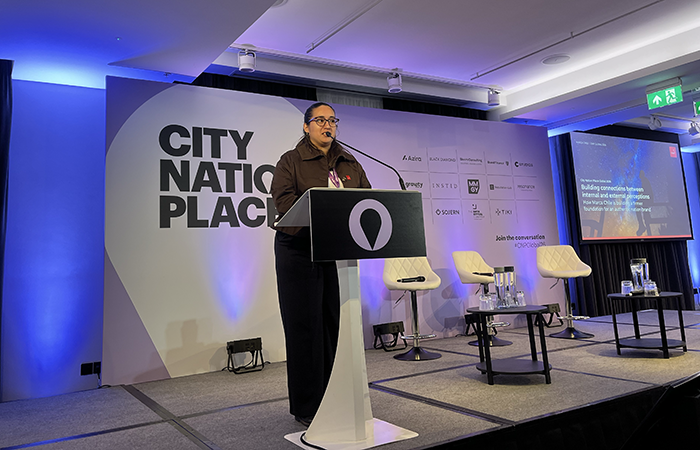


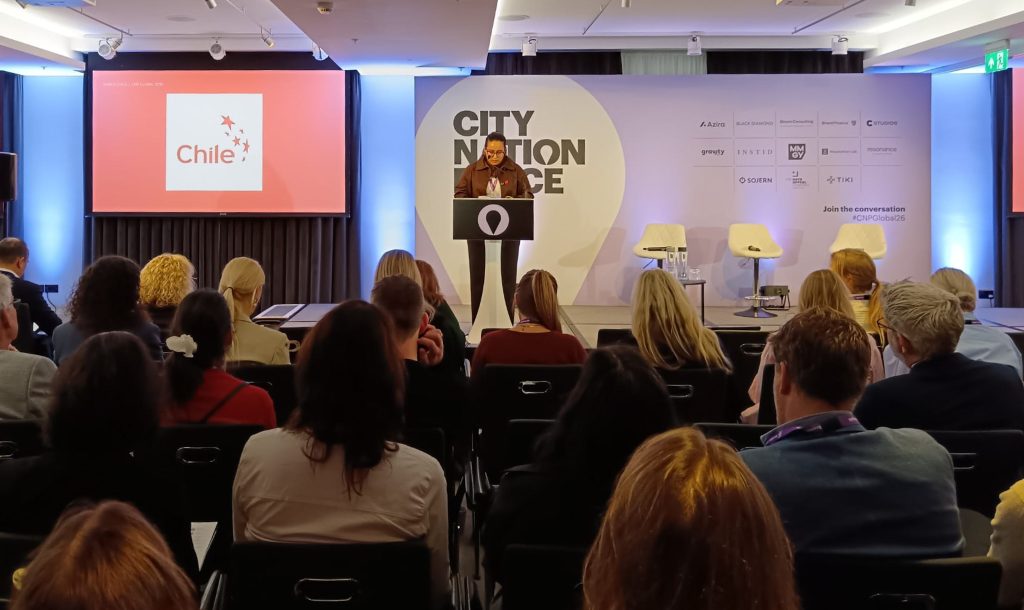
How can we build an authentic country brand if we know what the world thinks of us but don’t know how we see ourselves? That was one of the questions that guided the work of Marca Chile and was at the heart of the presentation given by Constanza Rojas, Strategic Alliances Coordinator, at City Nation Place Global, a conference in London that brought together experts in country and regional branding.
The presentation, titled “Building Connections Between Internal and External Perceptions: How Marca Chile Is Building a Firmer Foundation for an Authentic Nation Brand” (Building connections between internal and external perceptions: How Marca Chile is laying a firmer foundation for an authentic nation brand), explored the institution’s experience with the Chilean Pride Study, a research project that, since 2019, has sought to understand how people perceive their country, which aspects of their identity they value, and what lies behind that sense of pride.
The study is based on a premise: to project a representative and credible image of Chile internationally, it is also necessary to understand how its own residents view the country. This involves understanding what they identify as their own, what makes them feel proud, and what elements connect them to the country.
The latest survey, conducted in January 2026 among 3,200 adults, revealed that 71% felt a strong sense of pride in Chile, while 78% said they were proud to be Chilean. The results showed that these two feelings did not necessarily go hand in hand; in other words, it was possible to be critical of the country’s situation while still maintaining a strong sense of belonging. In-depth interviews shed light on some of the reasons behind this sentiment, including shared identity, resilience, solidarity, and Chile’s international recognition.
From Identity to International Strategy
Landscapes, geography, and natural heritage continue to be important sources of pride for Chileans, according to all surveys. However, the study also showed that other areas—such as astronomy, renewable energy, science, innovation, and biodiversity—were beginning to be included among the things that Chileans themselves valued about their country.
For Marca Chile, gaining insight into these perceptions made it possible to broaden the narrative projected internationally. In addition to the attributes for which the country was already recognized, others were highlighted—such as the people, knowledge, and capabilities that are driving its development. This confirmed the strategy the institution has been pursuing for several years: that is, it is not enough to showcase what the country has to offer geographically; it is also essential to highlight what its people are capable of creating and contributing to the world.
This approach ties in with various initiatives aimed at promoting the country brand. One of them is “Made by Chileans,” a licensing program that allows companies and organizations to use the “Marca Chile” seal to highlight their Chilean origin in international markets. Currently, the network includes more than 4,000 licensed organizations. There is also the international campaign “You Will See,” which brings together the country’s natural and cultural diversity with the energy, talent, and capabilities that are transforming Chile. Joining these efforts is “Somos Chile,” an initiative developed in partnership with Santiago International Airport that spotlights people from diverse backgrounds who contribute to the nation’s development.
While these initiatives do not necessarily stem from the study, its findings provide a better understanding of how to connect with what Chileans value about their country and how to help project that image abroad.
That was precisely one of the insights that Marca Chile shared in London: building an authentic country brand requires bridging internal and external perceptions, incorporating the perspectives of those who live in the country into the way Chile presents itself to the world.