

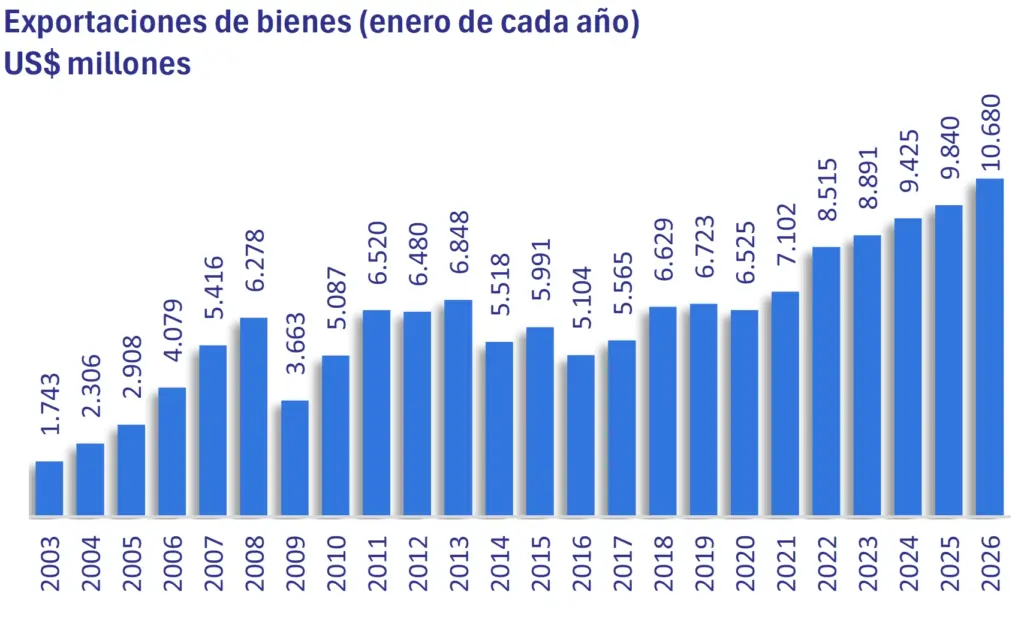
During January 2026, Chile's trade exchange totaled US$18.041 billion, marking a 3.1% increase over the same month in 2025 (+US$550 million), thus accumulating a record of 17 months of successive increases. The country thus began 2026 with a record figure, surpassing the US$18 billion mark for the first time in just the first month of the year.
This was revealed in the latest version of Chile's Monthly Foreign Trade Report, prepared by the Undersecretary of International Economic Relations, with data from the Central Bank and the National Customs Service.
Exports of goods totaled US$10.68 billion, starting the year with growth of 8.5% (+US$840 million), marking the highest amount ever recorded for the first month of a year, with record values for both non-traditional and traditional shipments.
Sector analysis
In terms of categories, the country's export performance in the first month of the year was as follows:
Mining exports rose to US$5.558 billion, reflecting a 12.1% increase compared to the same period in 2025 (+US$601 million), setting a new record for foreign sales.
According to the report, the dynamism exhibited by the country's largest export sector was sustained by copper, which generated returns of US$4.546 billion, representing an annual increase of 7.9% (+US$332 million), with rises in foreign sales of both cathodes and concentrates.
Other products that contributed significantly to the increase in mining shipments in January were gold, lithium carbonate, iron, molybdenum concentrate, and silver. All of these showed increases of more than US$35 million. Given the positive performance of almost all components of the sector, mining alone accounted for 52% of Chile's shipments in the first month of the year.
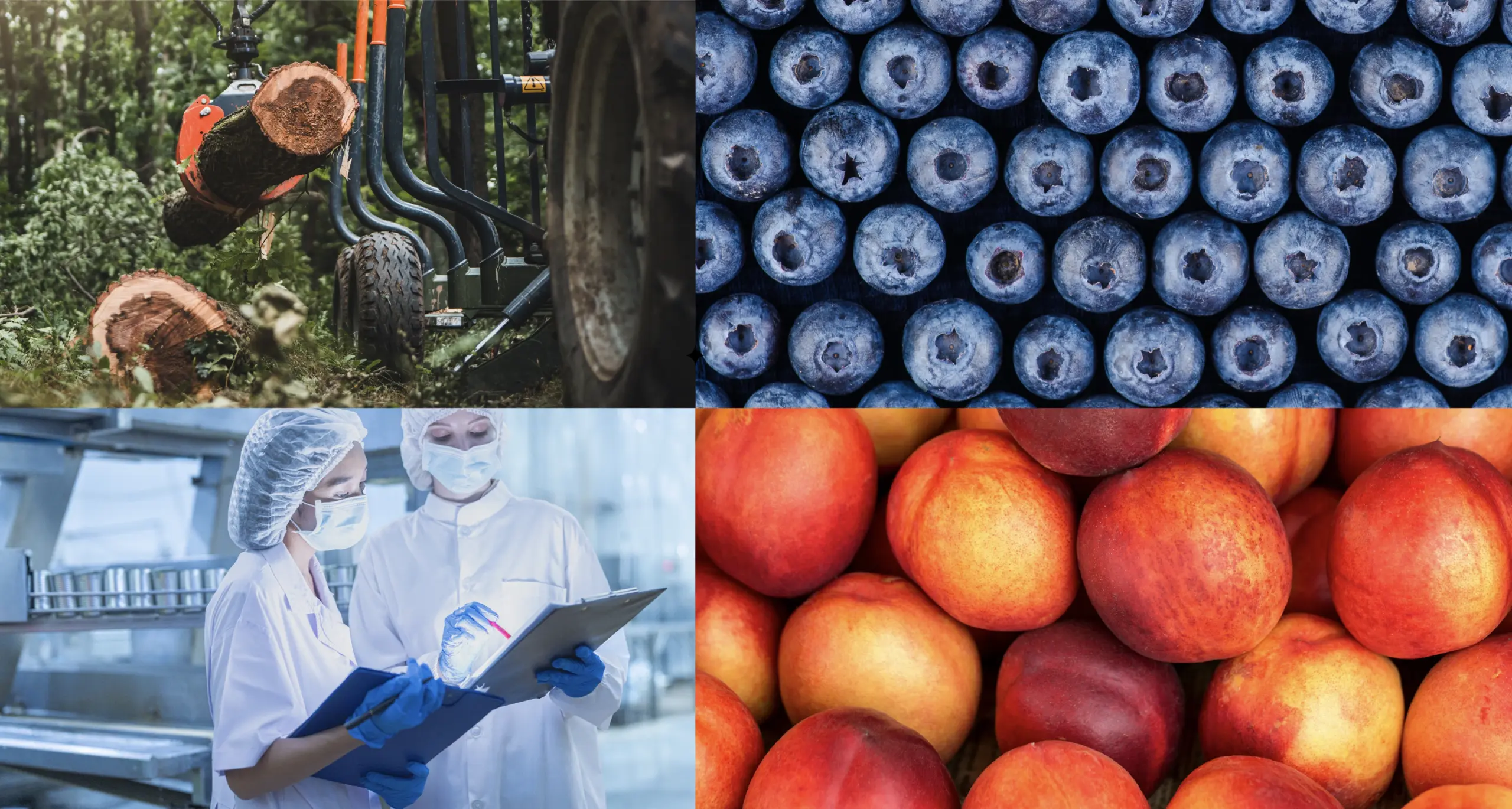
Meanwhile, the fruit sector started the year with exports worth US$1.771 billion, representing 17% of the country's foreign sales. January shipments were led by fresh cherries (US$1.231 billion), followed at a distance by fresh blueberries (US$228 million) and fresh nectarines (US$66 million), among others.
Foreign sales in the food industry totaled US$1.318 billion in January, marking a 13% increase (+US$152 million) and achieving the best figures ever recorded for the start of the year.
This growth was sustained by exports of salmonids, frozen horse mackerel, tomato puree, frozen deep-sea cod, and frozen strawberries, among other products.
Organic foods, meanwhile, totaled US$72 million in shipments, showing an increase of 15.9%, sustained by the boom in foreign sales of fresh blueberries and frozen fruits (strawberries, raspberries, and cherries).
The study added that bottled wine exports totaled US$108 million, down 9.4% compared to January 2025 (-US$11 million), due to a decline in shipments of red blends. This was largely offset by an increase in exports of Cabernet Sauvignon, Merlot, Riesling, and other varieties.
In turn, forestry manufacturing totaled shipments of US$490 million, marking a 15% decline compared to the first month of 2025 (-US$86 million), due to lower shipments of cellulose, shaped wood, and cardboard.
However, shipments of Douglas fir lumber, plywood, corrugated paper, wood pellets, self-adhesive paper rolls, prefabricated buildings, agglomerated cork stoppers, tool handles, prefabricated offices, and doors grew in the sector.
Chemical manufacturing began the year with shipments worth US$862 million, up 47% compared to January 2025 (+US$276 million), driven by higher returns on iodine and a strong recovery in shipments of lithium sulfate and lithium hydroxide. Potassium nitrate and fertilizers also saw notable increases.
The report indicated that machinery and equipment began the export year with returns of US$144 million, marking an increase of 29.9% (+US$33 million), due to increased shipments of machinery for mineral processing, parts and components for drilling and boring machinery, washing machines, stoves, and refrigerated display cases, among other manufactured products.
Exports of traditional and non-traditional goods
In January, exports of traditional goods accounted for 47.4% of total exports. Non-traditional shipments, meanwhile, accounted for 52.6%.
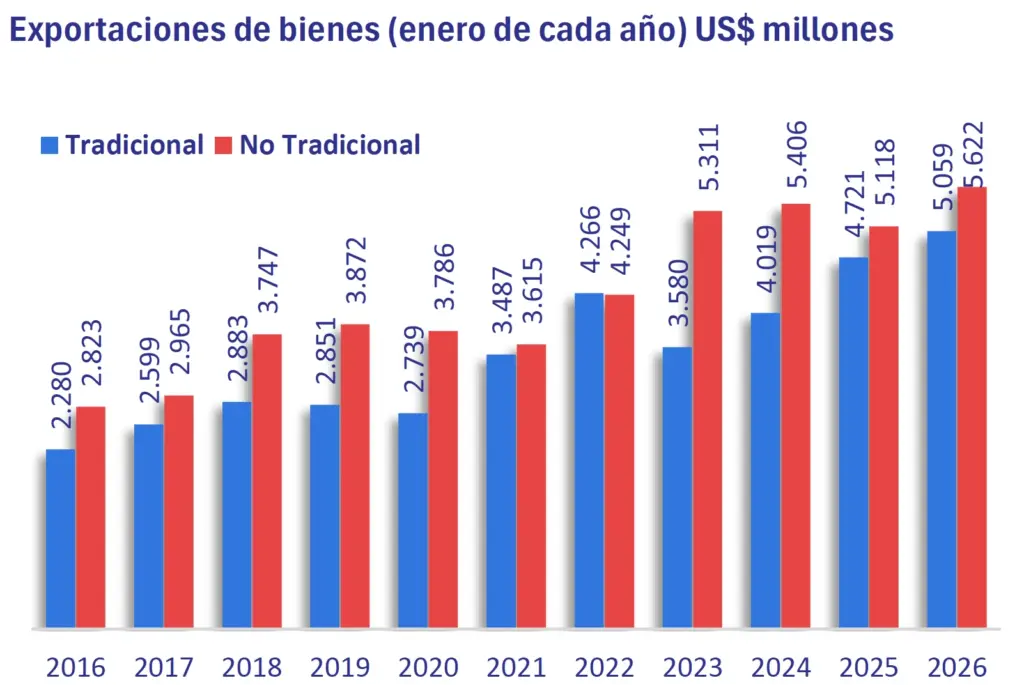
Meanwhile, the first month of the year closed with non-traditional exports reaching US$5.622 billion, an increase of 9.8% (+US$503 million) compared to January 2025, marking the best start to the year on record. More specifically, the increase in non-traditional shipments has been led by hazelnuts, frozen horse mackerel, fresh blueberries, frozen salmon fillets, fresh plums, fresh nectarines, fertilizers, ammonium nitrate, copper wire, and parts for drilling or boring units, among others.
Exports of services rose to US$412 million, an increase of 37.4% compared to the first month of 2025 (+US$112 million). Among the most relevant services during this period were aircraft and aerospace maintenance and repair services, which reached US$141 million, followed by business management consulting services (US$42 million), financial services associated with expert witnesses (US$ 16 million), information technology consulting (US$ 15 million), and logistical support (US$ 14 million).
Read the original article on the website of the Undersecretary of International Economic Relations.