


Food, mining, manufacturing, and services have driven the country’s trade to grow consecutively over the past 18 months. This is according to the latest Monthly Trade Report prepared by the Undersecretariat for International Economic Relations (SUBREI), based on data from the Central Bank and the National Customs Service.
The analysis noted that, in the first two months of 2026, Chile’s trade volume totaled US$33.879 billion, marking a 5.7% increase compared to the same period in 2025 (+US$1.839 billion), thus bringing the cumulative total to eighteen consecutive months of growth.
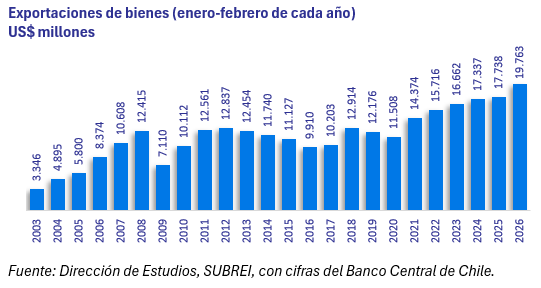
The report revealed that in the January-February period of this fiscal year, Chilean exports totaled US$19.763 billion, representing an 11.4% increase (up US$2.025 billion), marking the highest figure on record for the first two months of a year, with record levels for both non-traditional and traditional exports.
Sector analysis
According to the report, mining exports rose to US$11.266 billion, an increase of 19.4% compared to the same period in 2025 (+US$1.834 billion), setting a new record for foreign sales.
Copper remained the country’s leading export category, generating US$9.243 billion in revenue—a 12% increase—driven by higher exports of both cathodes and concentrates. Other products that contributed significantly to the increase in mining exports during the first two months of the year were lithium carbonate, gold, iron, silver, and molybdenum concentrates, all of which showed double-digit growth.
The fruit sector recorded exports of US$2.361 billion, reflecting a 12.2% decline compared to the same period in 2025. This was due to lower returns on shipments of fresh cherries. This decline has been largely offset by increases in hazelnuts, fresh nectarines, fresh plums, avocados, and other products.
The report highlighted that the food industry’s exports rose to US$2.521 billion in the first two months of the year, marking a 10.6% increase.
Meanwhile, exports of bottled wine totaled US$191 million during the period under review, representing a 3% increase compared to the same period in 2025. The recovery in shipments of this product category has been led by the varieties Sauvignon Blanc, Chardonnay, Cabernet Sauvignon, Merlot, Riesling, Viognier, Syrah, Carmenère, vermouth, and sparkling wines.
The forestry sector as a whole recorded shipments totaling US$882 million, representing a year-over-year decline of 17.2%, due to lower shipments of pulp, lumber, moldings, and cardboard.
Meanwhile, the chemical manufacturing sector recorded shipments totaling US$1.508 billion, reflecting a 39.8% increase so far this year, driven by higher returns from iodine and the recovery in shipments of lithium sulfates and hydroxides.
Machinery and equipment generated revenues of US$250 million, representing an 11.8% increase, driven by higher shipments of mineral processing machinery, iron parts and components, refrigerated display cases, and other manufactured goods.
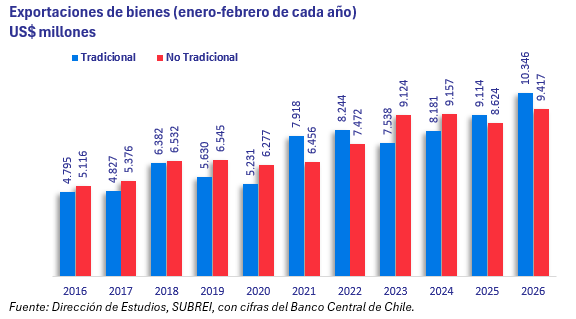
The study found that, as of the second month of 2026, exports of traditional goods accounted for 52.3% of the country’s total foreign sales. Non-traditional exports, meanwhile, accounted for 47.7%.
Exports of non-traditional goods
The report noted that, as of the end of February, non-traditional exports exceeded US$9.417 billion, representing a 9.2% increase compared to the same period in 2025—the strongest start to the year on record.
More specifically, the increase in non-traditional shipments has been driven by gold, frozen horse mackerel, silver, frozen salmon fillets, fresh plums, hazelnuts, fertilizers, fresh nectarines, fresh plums, fresh avocados, drilling and surveying equipment, bacon, tankers, safety glass, quillay bark, beer, and seeds, among others.
Exports of services
Meanwhile, service exports reached a historic milestone, with exports totaling US$672 million so far in 2026. This figure represents a 14.5% increase compared to the same period in 2025, further solidifying the sector’s sustained growth.
During the period under review, 165 different services were provided abroad, with 83 of them showing an increase compared to the previous year. The services leading Chilean exports were aircraft maintenance and repair (US$207 million), business management consulting (US$52 million), marketing management consulting (US$33 million), logistics support (US$28 million), and information technology consulting (US$23 million).
Read the full article on the website of the Undersecretariat for International Economic Relations.