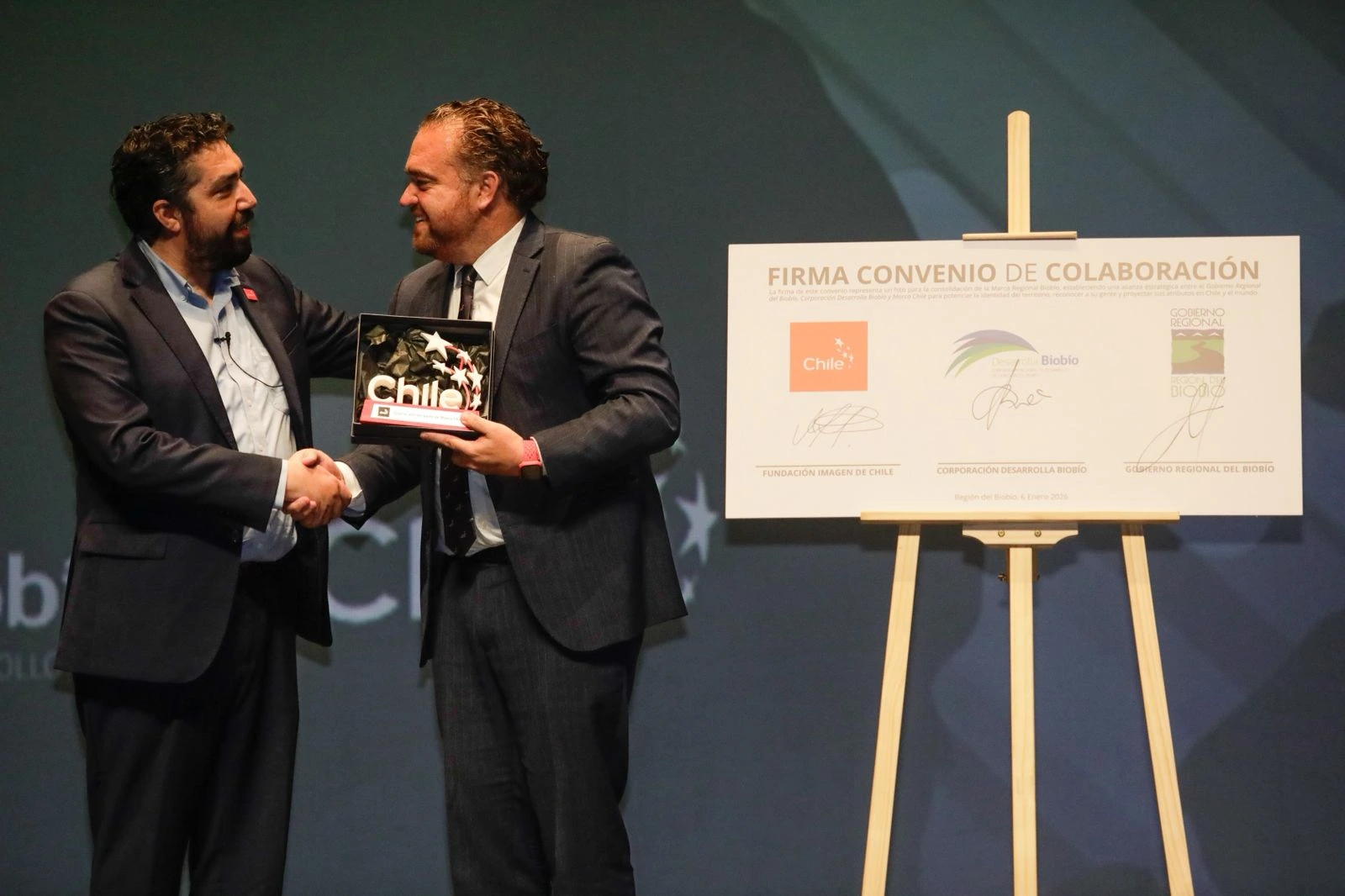


Regional and provincial authorities, representatives of trade unions, academia, and civil society gathered at the Biobío Regional Theater to participate in the so-called "Milestone 1," an event centered on the signing of a collaboration agreement between the Biobío Regional Government, the Biobío Development Corporation, and the Imagen de Chile Foundation.
The agreement formalizes Marca Chile's technical and strategic support in the process of building the Biobío regional brand, with the aim of developing a narrative and graphic identity that reflect the distinctive attributes of the territory and strengthen its positioning, international projection, and future development.
The initiative is part of the challenge of promoting a key region for the country. Biobío is Chile's second most industrialized region and one of the most important in economic and productive terms, with a strong presence of the forestry industry—the largest in the country—steel, agriculture, cellulose, and energy generation, as well as being an important cultural, educational, and social hub.
This leadership coexists with territorial development challenges, reinforcing the importance of having a regional brand that articulates identity, pride, and strategic projection.
In this context, regional governor Sergio Giacaman highlighted the importance of moving forward in building a shared regional identity. "This agreement allows us to establish a key link to shape the identity of Biobío through a brand that we can show to Chile and the world. We believe it is necessary to work on capturing who we are in a brand," he said.
The regional authority also emphasized that Biobío already enjoys recognition built up over its history and productive development. "The world knows Biobío as a resilient region, which has risen several times after earthquakes, with great productive and industrial capacity, but also for its natural beauty. That is what we must be able to capture in a permanent brand and speak with pride about our region, "he said.
Collaborative construction
Danny Baesler, acting general manager of Corporación Desarrolla Biobío, highlighted the high turnout and representative nature of the process, which is being developed under a governance model that integrates public, private, social, and academic actors.
"Our goal is to promote a representative brand that will allow us to be recognized both nationally and internationally, and that will contribute directly to the strategy of regional development, internationalization, and attracting investment," he said.
For his part, Víctor Palma, Director of Strategic Alliances at Fundación Imagen de Chile, highlighted the role of Marca Chile as a strategic partner for the regions in their positioning processes.
"At this event, which brought together more than 600 people, we were able to show what we do as an institution and how, through our work, we project Chile to the world, accompanying the regions in co-creation processes such as this one," he said.
In recent years, Marca Chile has been systematically supporting the country's regions in building their regional brands, contributing methodology, experience, and strategic vision. One example of this is the Los Ríos Region, which has made significant progress, gathering extensive information from public, private, academic, and social actors, defining a territorial narrative, and nearing completion of its graphic identity.