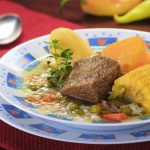
The cuisine of this region is the result of a fusion between indigenous cultures—particularly Andean ones—and Spanish influence. Its dishes are deeply rooted in the arid climate, the high-altitude plateau, and the available resources, giving rise to a cuisine that is both an adaptation and an expression of identity.
Traditional dishes from the north
Calapurca
Of pre-Hispanic origin, this dish is made with meat, potatoes, corn, and hot broth. Its distinctive feature is the use of volcanic stones, which help maintain the dish’s temperature. It is a staple of community celebrations in the Altiplano and is also eaten in southwestern Bolivia.
Chairo
A traditional Andean stew, originating in the Bolivian Altiplano and also found in southern Peru and northern Chile. It is a thick, hearty soup made with meat, root vegetables, and Andean grains. It is an iconic dish of Altiplano cuisine due to its rich flavor and cultural significance.
Roast alpaca
Cooked over an open fire, this dish is typical of the Andean regions of Peru, Bolivia, and northern Chile. Alpaca meat is known for being lean, high in protein, and low in fat. It is traditionally served with native potatoes.
Patasca
Also known as pataska, it is a hearty stew or broth typical of northern Chile and Andean communities. It is known for its rich flavor and for being a comforting dish, ideal for braving the cold temperatures of the highlands.
Each of these dishes reflects the history, geography, and cultural diversity of northern Chile. More than just recipes, they are living expressions of an identity shaped by its environment.
In this region shaped by the desert and Andean heritage, northern cuisine does more than just nourish: it also transmits knowledge, preserves traditions, and strengthens a sense of belonging. Discovering these dishes is, ultimately, a way to connect with Chile’s cultural richness and better understand its identity.