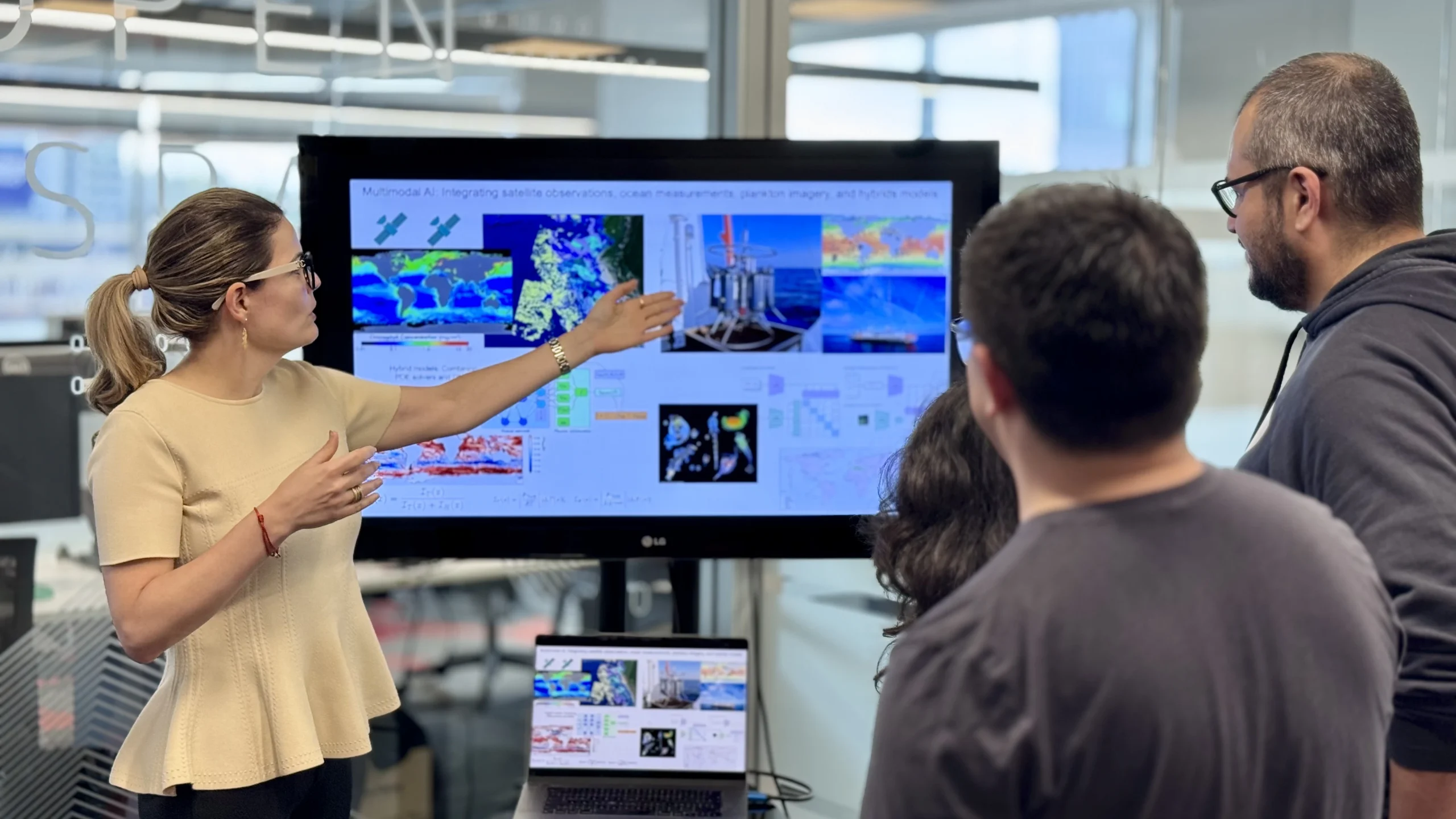


France’s National Institute for Research in Digital Science and Technology (Inria) announced that its center in Chile, Inria Chile, is one of the winners of the Google.org Impact Challenge: AI for Science. The local institution will thus receive US$2.5 million to build a foundational multimodal world model of the ocean, which will serve as the basis for a digital twin that will provide a better understanding of Earth’s last great mystery.
Inria Chile is one of 17 organizations worldwide selected from more than 3,000 applications from 30 countries, which will share a total of US$36 million. It is the only institution in Latin America among the winners, alongside leading universities and research institutions from around the world.
The development of this model aims to integrate data that is currently analyzed in a fragmented manner in order to better understand ocean dynamics and anticipate changes in its ecosystems. Although this system regulates the climate and feeds billions of people, it remains one of the least observed systems on Earth. Its data—derived from satellites, buoys, and biological and genomic samples—remain scattered across incompatible formats, making it difficult to establish reliable links between phenomena such as ocean warming and acidification and their effects on marine life, including harmful algal blooms, coral bleaching, and the collapse of fisheries.
To address this challenge, the MOFOMO (Multimodal Ocean Foundation Models for an Ocean Digital Twin) project will develop an open, multimodal foundational world model that integrates physical, biological, and genomic observations of the ocean. Coupled with physics-based models, it will enable the generation of reliable and explainable forecasts, serving as the foundation for building a digital twin of the ocean.
Talent, technology, and science to push the boundaries
“For us, AI for science means designing a new generation of models: models that learn from physics, biology, and ocean genomes, using sparse and heterogeneous data while respecting the laws that govern it, so that we can predict how climate change will affect marine life before it happens,” says Nayat Sánchez-Pi, director general of Inria Chile and principal investigator of MOFOMO.
“The support from Google.org allows us to accelerate the development of this digital twin of the ocean: training on a large scale, publishing openly, and advancing the solutions the ocean needs. For us, that is AI for the common good. Being selected as one of 17 winners out of more than 3,000 applications is a recognition of the work carried out over the years at Inria Chile,” he adds.
“We are living in an extraordinary time for science: advances in artificial intelligence are opening up possibilities for discovery that were hard to imagine just a few years ago. Inria Chile combines AI with deep scientific knowledge in an ambitious and creative way to tackle some of humanity’s most important questions. “It is an honor to support their work as they apply AI to the ocean—the least-observed system on Earth—to push the boundaries of scientific discovery and turn revolutionary ideas into real impact,” says Leslie Yeh, Director of Scientific Progress at Google.org.