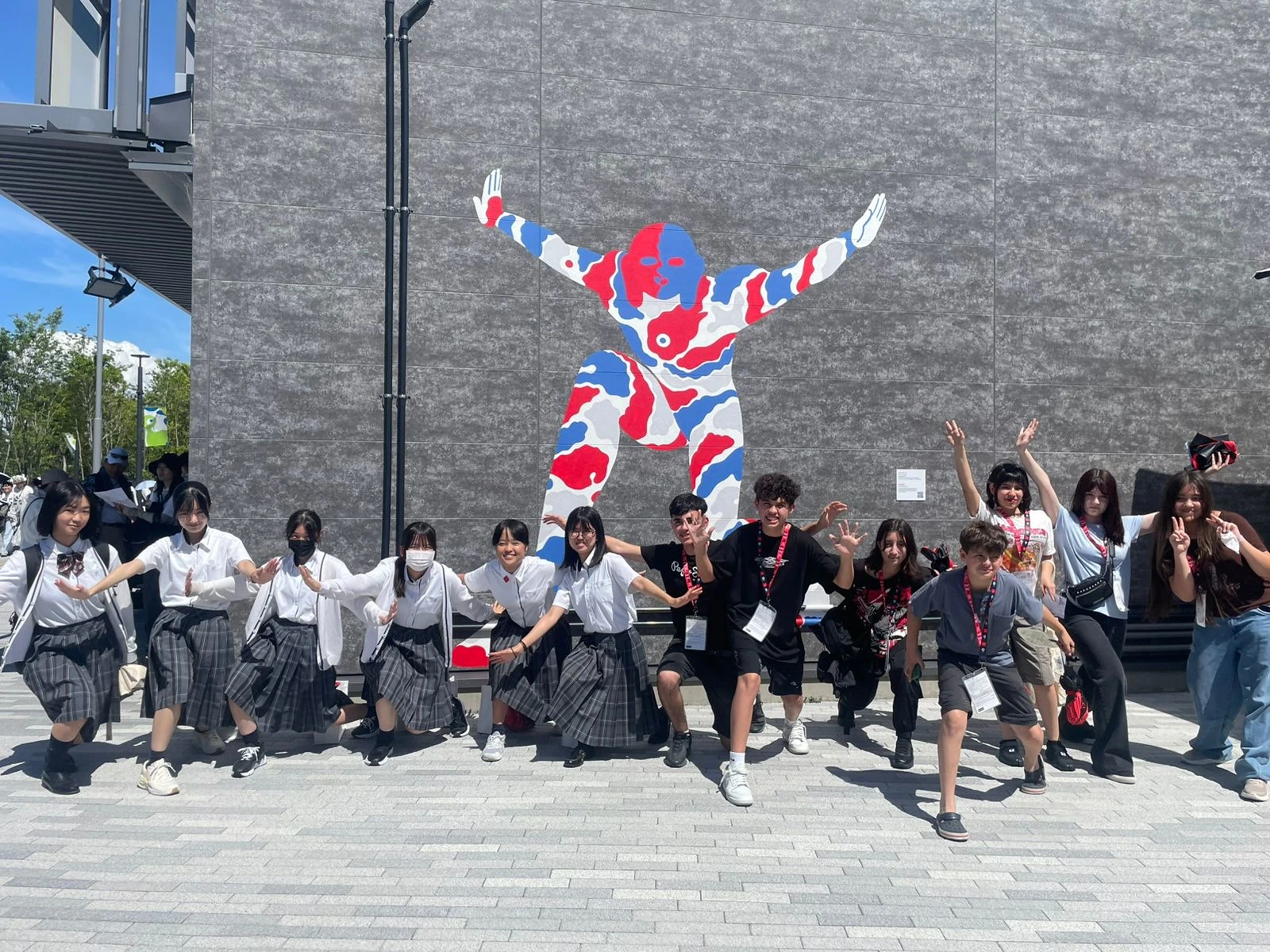


Within the framework of Chile's participation in the World Expo 2025 held in Osaka, Japan, the thematic week "Play Workshop: Asobikobo" took place from July 19 to 24, an initiative that focused on children and youth as agents of change.
The project, promoted by ProChile (the Foreign Ministry's General Directorate of Export Promotion) in collaboration with the Mirador Interactive Museum (MIM), selected seven young Chileans between the ages of 13 and 16 to live a unique experience of cultural and creative exchange with twelve other Japanese teenagers from Osaka International Junior High School.
Those selected, chosen from more than fifty applicants, were Renato Ulloa (16), Julián Aguilar (13), Ana Delgado (13), Julián Pinochet (13), Javiera Quiroz (14), Rafaela Pérez (16) and Victoria Mena (13), from both the Metropolitan Region and the Valparaíso Region.
The "Game Workshop: Asobikobo" (in Japanese, "asobi" is game and "kōbō" means workshop) proposed the game as a way of being in the world, a tool for imagining, connecting and collaborating. Thus, the seven young Chilean men and women recorded their reflections and discoveries through a personal logbook, an input that later gave rise to the creation of a game that imagined possible futures for humanity.
"This theme week was one of the most significant of our participation in Expo Osaka 2025 and coincided with the official theme week of the Expo entitled 'Play and Learn'. This activity invited us to look at the future from creativity, empathy and imagination, where the protagonism of young people was fundamental: they are the ones who are called to design new ways of inhabiting the world, and from Chile we wanted to give them a real space to express themselves and build together," said Paulina Nazal, Chile's Commissioner General for Expo Osaka 2025.
"For the MIM, being part of Expo Osaka with this project represented a unique opportunity to share with the world our vision of learning through play, exploration and wonder. This participation not only allowed us to project our educational and museographic proposal at an international level, but also to provide a valuable experience of cultural and scientific exchange for the young people who represented Chile. We deeply believe in the impact that this experience had on their personal development and their view of knowledge and the world," said Enrique Rivera, executive director of the Museo Interactivo Mirador.
Laboratories, meetings and collective creation
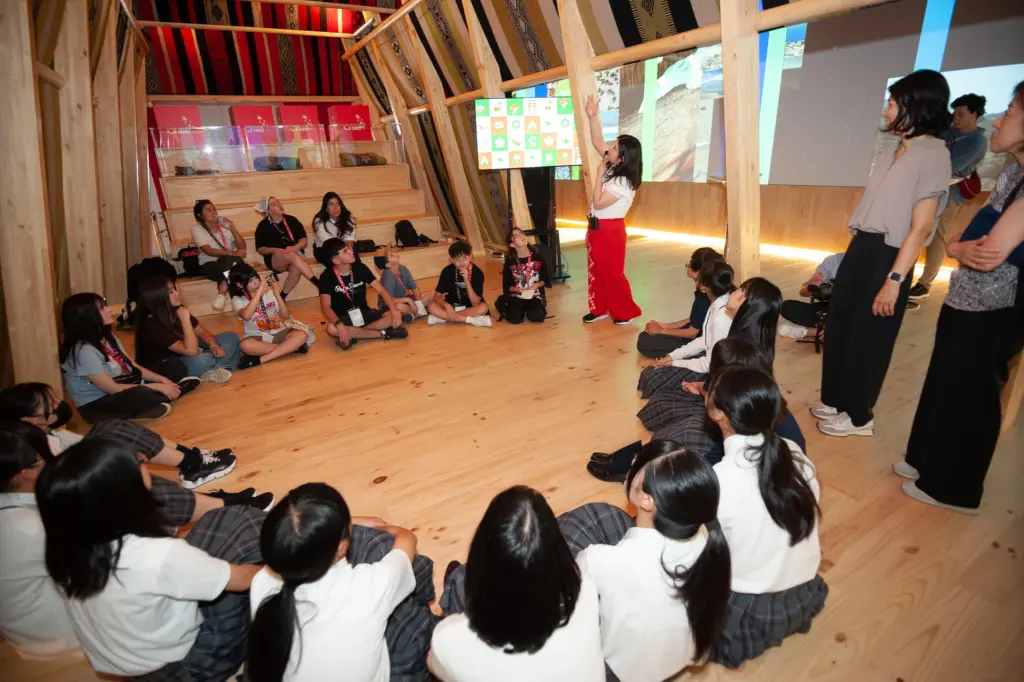
Preparation for this week began with eight sessions of experimentation between May and July at the Mirador Interactive Museum, where the young people worked on games as a universal language, beyond language barriers. Cards, maps, soundscapes, collages and instructions were part of the devices that guided the process. The reflection addressed topics such as landscape, nature, cosmovision, pop culture, future, among others.
In addition, two central interaction actions were carried out with the Japanese youth. The first was a sensory correspondence, where, through a digital and paper epistolary exchange, they shared sounds recorded from their cell phones and textures captured with the frottage technique, answering questions such as: what does my city sound like? what texture does my city have?
The second action was an assignment: each group prepared a bag with different elements representative of their culture - a game, a smell, a sweet, among others - to be presented at one of the meetings in Osaka.
During their stay between July 19 and 24, the group participated in exchange sessions with young Japanese, learned about their culture and gathered experiences for the creation of the game. The first face-to-face meeting was held on Saturday 19 at the Chile Pavilion, under the title "Makün: The Mantle of Chile".
The following days included visits to Osaka International High School, the 1970 Expo Osaka Memorial Park, the Osaka Science Museum and other city landmarks.
On the afternoon of July 24, the group made an open presentation to the general public of the Expo, sharing the process they went through, from the laboratories at mim to the discoveries, encounters and reflections collected in Osaka, all captured in their logs.
Upon their return to Chile, the participants completed the development of the game in face-to-face sessions at mim, thus consolidating a transformative experience that transcended borders.

